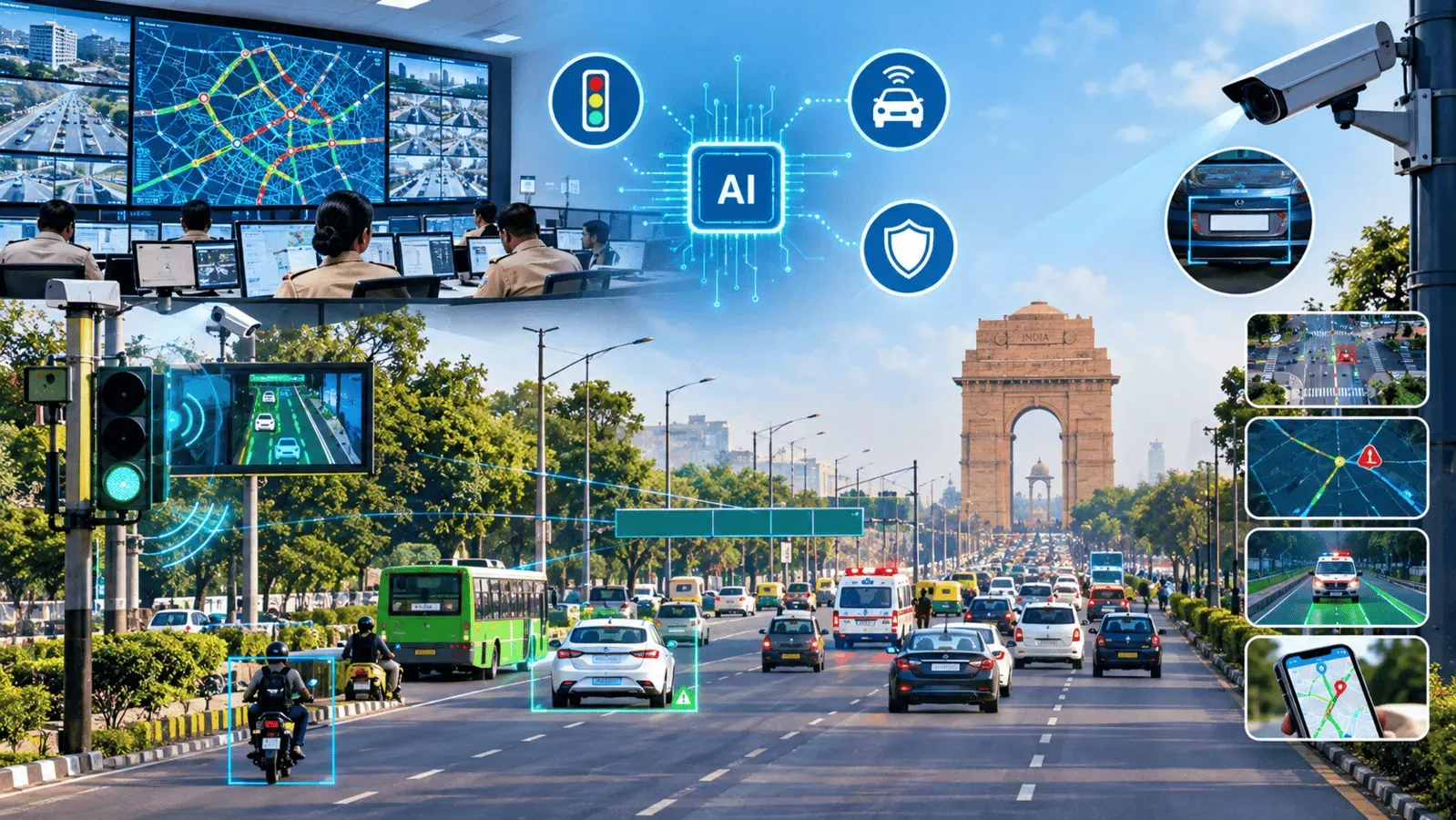
Delhi is launching a new Intelligent Traffic Management System (ITMS) to improve traffic flow and road safety using advanced technology. This system will cover 42 traffic corridors and will be implemented in three phases over 24 months, followed by five years of operation and maintenance. The project aims to make traffic signals adaptive, enforce traffic rules automatically, and prioritize emergency vehicles.
- The ITMS uses artificial intelligence and adaptive traffic signals to respond to real-time traffic conditions.
- It will cover 42 traffic corridors in Delhi in three phases over two years.
- Automated enforcement will detect violations like red-light running, speeding, and illegal parking.
- Priority green corridors will be created for ambulances and emergency vehicles.
- Commuters will receive real-time traffic updates through digital platforms and signboards.
What is the scope of Delhi's new traffic system?
The Delhi Police will implement the ITMS across 42 identified traffic corridors. The project will be rolled out in three phases over 24 months, followed by five years of operation and maintenance. It is a ₹1,789.52-crore initiative approved by the Cabinet Committee on Economic Affairs, chaired by Prime Minister Narendra Modi.
How will adaptive traffic signals improve traffic flow?
Currently, many traffic signals operate on fixed timings, which do not adjust to changing traffic volumes. The ITMS will deploy Adaptive Traffic Control Systems that dynamically adjust signal timings based on real-time traffic conditions. These adaptive signals will coordinate along corridors to reduce delays and stoppages, making better use of existing road capacity.
How will the system help emergency vehicles?
The system will create green corridors that give priority to ambulances and other emergency vehicles. This will help them move quickly through traffic, potentially saving lives by reducing response times.
What kind of automated enforcement will the system use?
The ITMS will use technology-based enforcement to automatically detect traffic violations such as red-light and stop-line violations, speeding, wrong-way driving, non-use of helmets and seat belts, illegal parking, and mobile phone use while driving. AI analytics will also help identify stolen, blacklisted, and repeat offender vehicles.
How will commuters receive traffic information?
Commuters will get real-time updates on congestion, diversions, parking availability, and traffic conditions through Variable Message Sign boards and digital platforms. This information may also be shared with navigation service providers to help drivers plan their routes better.
Who is responsible for implementing and managing the project?
The Delhi Police will implement the project through a Master System Integrator selected via competitive bidding. The Centre for Development of Advanced Computing (C-DAC) will provide technical support as the Project Management Consultant, overseeing technical scrutiny, monitoring, validation, and acceptance during implementation and operation.
Why is this system needed in Delhi?
Delhi has around 71 lakh active registered vehicles, but road infrastructure has not expanded at the same pace. Traditional traffic management relies heavily on fixed signal timings and manual control, which are inefficient for fluctuating traffic volumes. The ITMS aims to optimize existing infrastructure by making traffic control more responsive and automated.