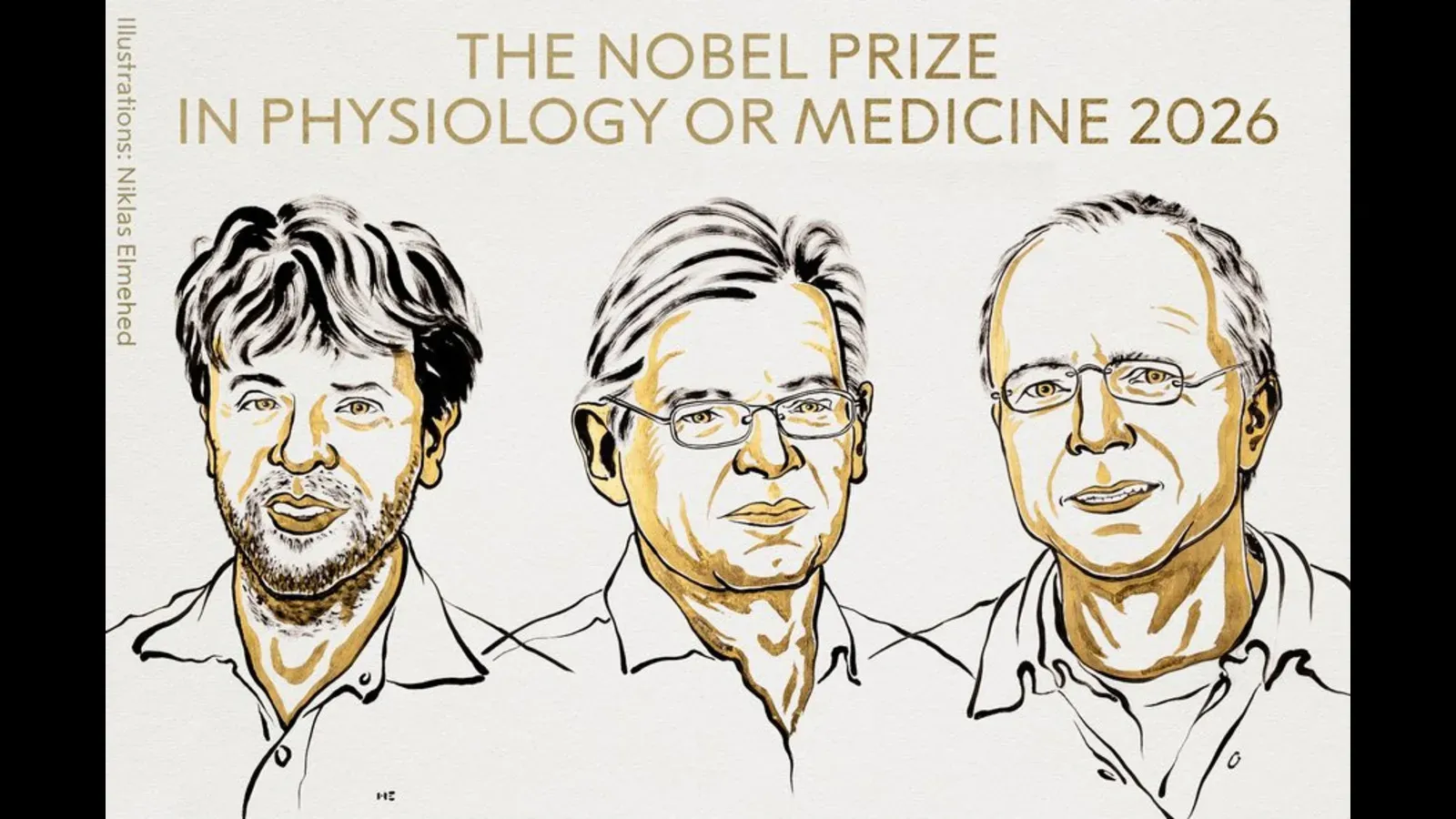
The 2026 Nobel Prize in Physiology or Medicine was awarded to Karl Deisseroth, Peter Hegemann, and Georg Nagel for their groundbreaking work in optogenetics. This innovative method allows scientists to control nerve cells using light, offering new insights into how the brain shapes memories, feelings, and behaviors.
- Optogenetics uses light to control nerve cells in living brains.
- The technique helps map brain functions and test cause-and-effect relationships.
- Discoveries involved light-gated ion channels, especially channelrhodopsin.
- Applications include studying neurological disorders and restoring vision.
What is optogenetics and why is it important?
Optogenetics is a method that uses light to control nerve cells by introducing light-sensitive proteins into them. This technique allows researchers to activate or deactivate specific neurons in living brains with precise timing. It has transformed neuroscience by enabling scientists to study how particular nerve cells influence memories, emotions, and behaviors.
How did the Nobel laureates contribute to optogenetics?
Peter Hegemann and Georg Nagel discovered channelrhodopsin, a protein found in algae that acts as a light-sensitive ion channel. When exposed to blue light, this channel opens and allows ions to flow into the cell, generating electrical signals. Karl Deisseroth introduced the gene for channelrhodopsin into nerve cells of rats and later demonstrated that blue light could trigger nerve signals in these cells. He further showed that this technique could control nerve cells in living mice, establishing the foundation for optogenetics.
How does optogenetics help scientists understand the brain?
Before optogenetics, scientists could only identify brain regions linked to certain functions but could not prove direct cause-and-effect relationships. Optogenetics allows researchers to activate or inhibit specific neural circuits and observe the resulting changes in behavior or brain activity. This ability has led to new discoveries about how memories form, how feelings arise, and how behaviors are controlled.
What are the practical applications of optogenetics?
Optogenetics is widely used in neuroscience research to study neurological and psychiatric disorders. It helps identify the neural circuits involved in diseases such as depression, anxiety, and Parkinson's disease. Additionally, researchers are exploring clinical uses, including restoring sight in people with visual impairments by controlling nerve cells in the eyes.
Who are the Nobel Prize winners and what are their backgrounds?
Karl Deisseroth is a professor of bioengineering and psychiatry at Stanford University and the Howard Hughes Medical Institute. Peter Hegemann is a senior professor of neuroscience at Humboldt University of Berlin. Georg Nagel is a professor of molecular plant physiology at the University of Würzburg. Their combined discoveries have opened a new era in brain research.
What does the Nobel Prize award include?
The Nobel Prize in Physiology or Medicine for 2026 includes a cash award of 12 million Swedish kronor, which will be shared equally among the three laureates. This prize is the first of the 2026 Nobel awards, with others in physics, chemistry, literature, peace, and economics to be announced in the following days.