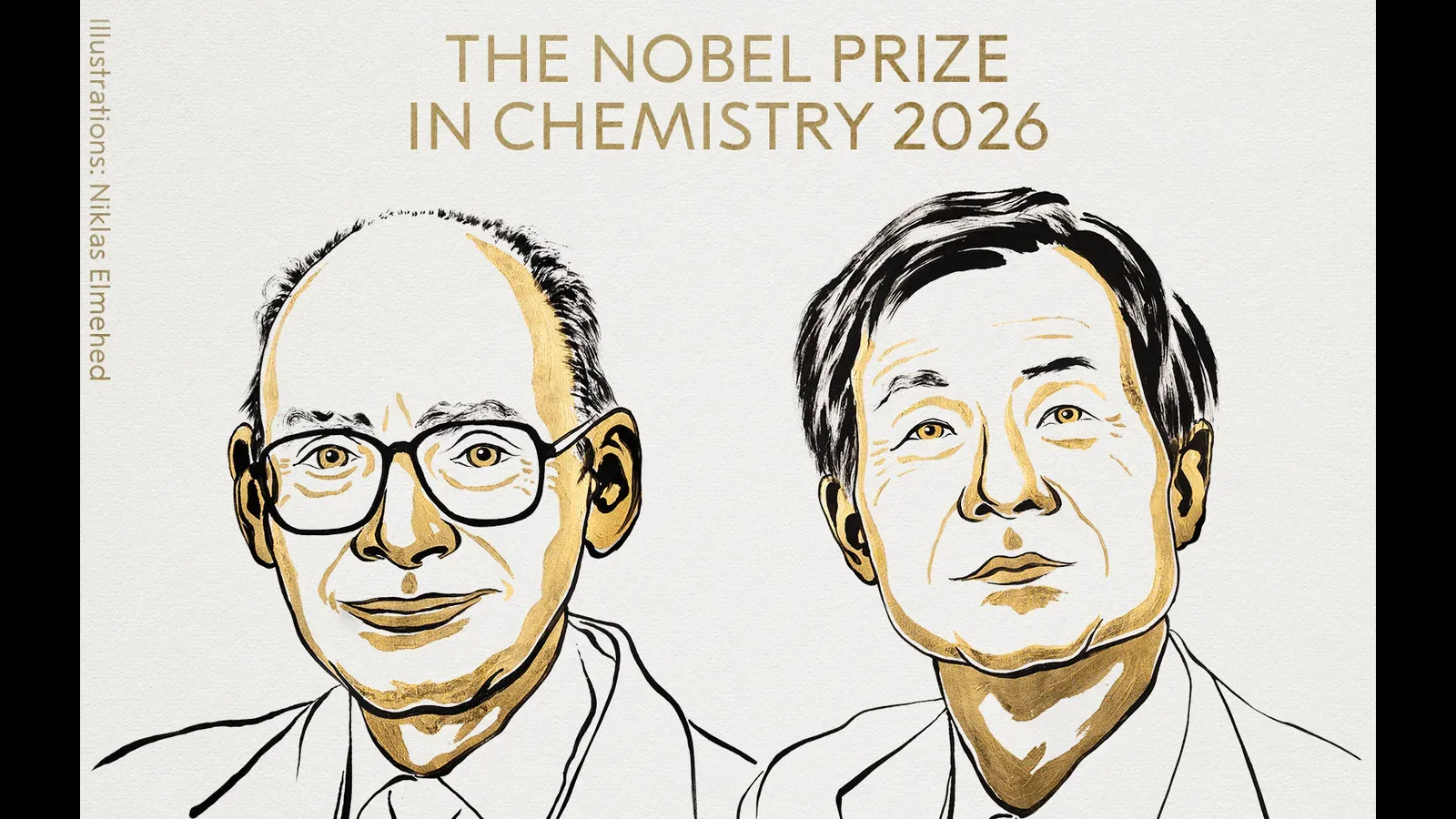
The 2026 Nobel Prize in Chemistry was awarded to Henri B. Kagan of France and Kenso Soai of Japan for their groundbreaking work on chemical asymmetry. Their discoveries explain how chemical reactions can produce predominantly one mirror-image form of a molecule, solving a mystery that has puzzled scientists for over a century.
- Henri Kagan and Kenso Soai received the Nobel Prize for their work on non-linear effects and autocatalysis in asymmetric organic synthesis.
- Their research explains how homochirality, or the predominance of one molecular mirror-image, can emerge spontaneously.
- The prize includes 12 million Swedish kronor, shared equally between the two laureates.
- This award is the third Nobel Prize announced in 2026, following medicine and physics.
What is the 2026 Nobel Prize in Chemistry about?
The Royal Swedish Academy of Sciences awarded the 2026 Nobel Prize in Chemistry to Henri Kagan and Kenso Soai for their discovery of non-linear effects and autocatalysis in asymmetric organic synthesis. Their work explains how chemical reactions can favor one mirror-image form of a molecule over another, a phenomenon known as homochirality.
Why is chemical asymmetry important?
Chemical asymmetry, or chirality, refers to molecules that exist in two mirror-image forms, much like left and right hands. Many biological molecules are chiral, and often only one form is biologically active. Understanding how one form becomes dominant is crucial for chemistry and biology, including drug development.
What did Kagan and Soai discover?
Kagan and Soai discovered non-linear effects and autocatalysis in asymmetric organic synthesis. Autocatalysis is a process where a chemical reaction accelerates itself. Their findings showed how such reactions can spontaneously produce a majority of one mirror-image molecule, explaining the origin of homochirality.
Who are Henri Kagan and Kenso Soai?
Henri B. Kagan is a professor emeritus at Université Paris-Sud in France. Kenso Soai is a professor emeritus at Tokyo University of Science in Japan. Both have made significant contributions to organic chemistry, especially in understanding asymmetric synthesis.
What is the significance of this Nobel Prize?
This Nobel Prize recognizes a chemical mystery that has lasted over 100 years. The discoveries by Kagan and Soai provide a deeper understanding of how life’s molecular building blocks can form in a specific orientation, which is essential for life as we know it.
How much is the Nobel Prize award?
The Nobel Prize in Chemistry for 2026 comes with an award of 12 million Swedish kronor. This amount will be shared equally between Henri Kagan and Kenso Soai.
Frequently Asked Questions
Q: What is homochirality?
A: Homochirality is the predominance of one mirror-image form of a chiral molecule over the other, which is important in biological systems.
Q: What is autocatalysis?
A: Autocatalysis is a chemical process where the product of a reaction speeds up the reaction itself.
Q: Why is asymmetric synthesis important?
A: Asymmetric synthesis allows chemists to produce molecules in a specific orientation, which is vital for creating effective pharmaceuticals and understanding biological processes.
The 2026 Nobel Prize in Chemistry highlights the importance of fundamental research in understanding the molecular origins of life and advancing chemical science.