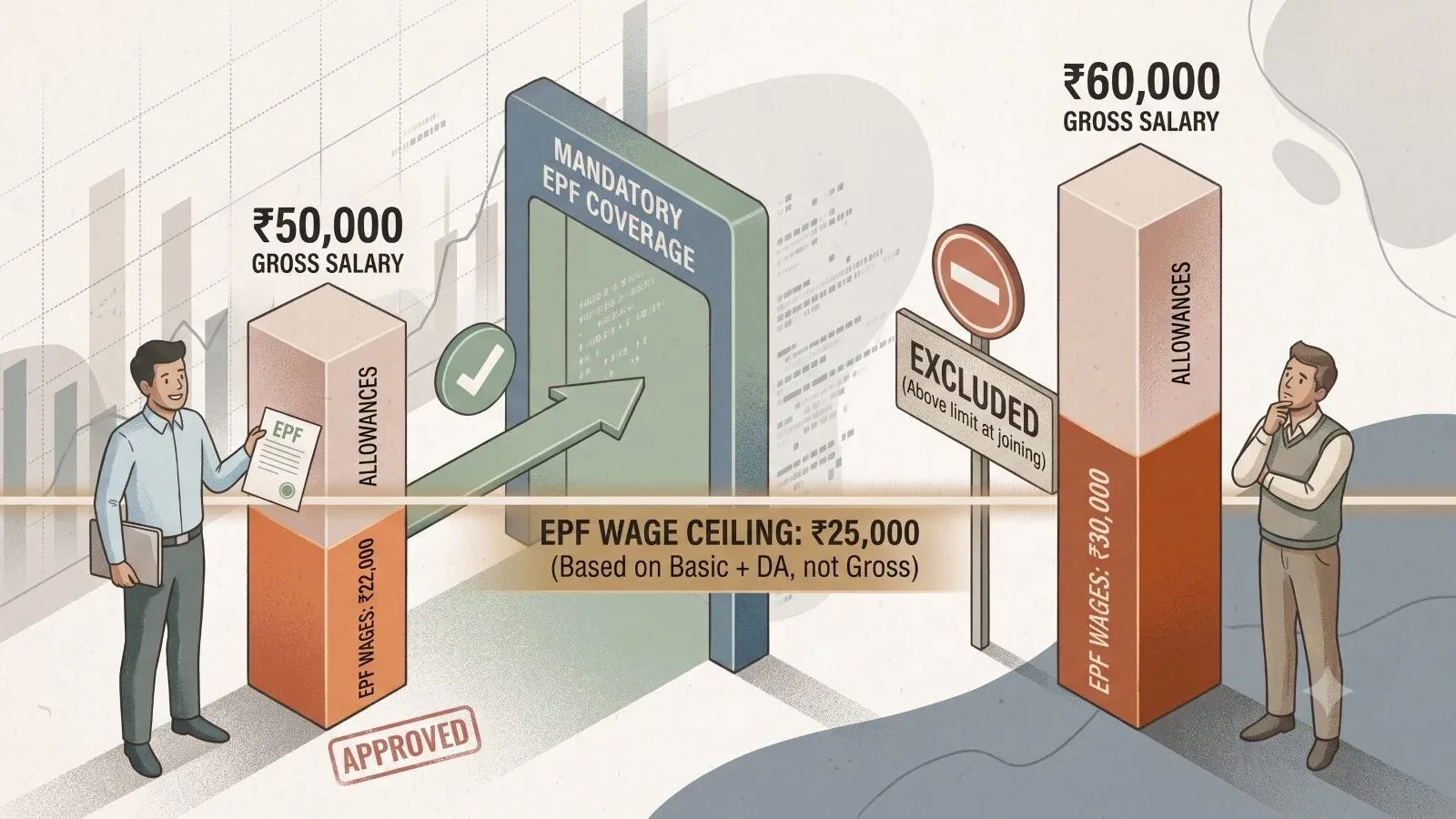
The Employees' Provident Fund (EPF) eligibility depends on a specific wage definition, not the total gross salary. This means an employee earning ₹50,000 may qualify for EPF benefits, while another earning ₹60,000 might not, based on their PF wages.
- EPF wage ceiling applies to wages defined under section 2(88) of the Code on Social Security, 2020.
- EPF wages include Basic Salary, Dearness Allowance, and Retaining Allowance only.
- Gross salary components like House Rent Allowance, bonuses, and overtime do not count towards EPF wages.
- Employees earning PF wages up to ₹25,000 must be members of EPF, EPS, and EDLI schemes.
- Employees with PF wages above ₹25,000 can opt in voluntarily with employer consent.
What is the difference between EPF wages and gross salary?
EPF wages are a narrower figure defined by law, including only Basic Salary, Dearness Allowance, and Retaining Allowance. Gross salary, however, includes additional components such as House Rent Allowance, special allowances, bonuses, and overtime. These extras do not count towards EPF wages.
Why does the wage ceiling matter for EPF eligibility?
The wage ceiling, currently ₹25,000, determines mandatory EPF membership. If an employee's PF wages exceed this ceiling, the employer and employee contributions are limited to the ceiling amount unless the employee opts to contribute on higher wages voluntarily.
How can an employee earning above the wage ceiling join EPF?
Employees earning PF wages above ₹25,000 can choose to join EPF voluntarily. This requires written consent from both the employee and employer, as per the Employees' Provident Funds Scheme, 2026. Such employees are classified as "excluded employees" but can still participate if they opt in.
What benefits does EPF membership provide?
EPF membership offers lifelong pension benefits upon retirement, survivor benefits for the family, and insurance coverage up to ₹7 lakh under the Employees’ Deposit Linked Insurance (EDLI) scheme. These protections are valuable regardless of salary size but depend on EPF eligibility based on PF wages.
Why might a ₹50,000 gross salary employee qualify but a ₹60,000 one may not?
Eligibility depends on PF wages, not gross salary. An employee with a ₹50,000 gross salary but PF wages of ₹25,000 qualifies for mandatory EPF membership. Conversely, an employee with a ₹60,000 gross salary but PF wages of ₹30,000 exceeds the wage ceiling and is not automatically covered but may opt in voluntarily.
Frequently Asked Questions
Q: What components count towards EPF wages?
A: Only Basic Salary, Dearness Allowance, and Retaining Allowance are included in EPF wages.
Q: Can an employee earning above ₹25,000 PF wages be part of EPF?
A: Yes, but only if both the employee and employer agree in writing to voluntary membership.
Q: Does gross salary determine EPF contributions?
A: No, EPF contributions are based on PF wages, not the total gross salary.
Q: What benefits do EPF members receive?
A: Members receive retirement pension, family survivor benefits, and insurance coverage under the EDLI scheme.