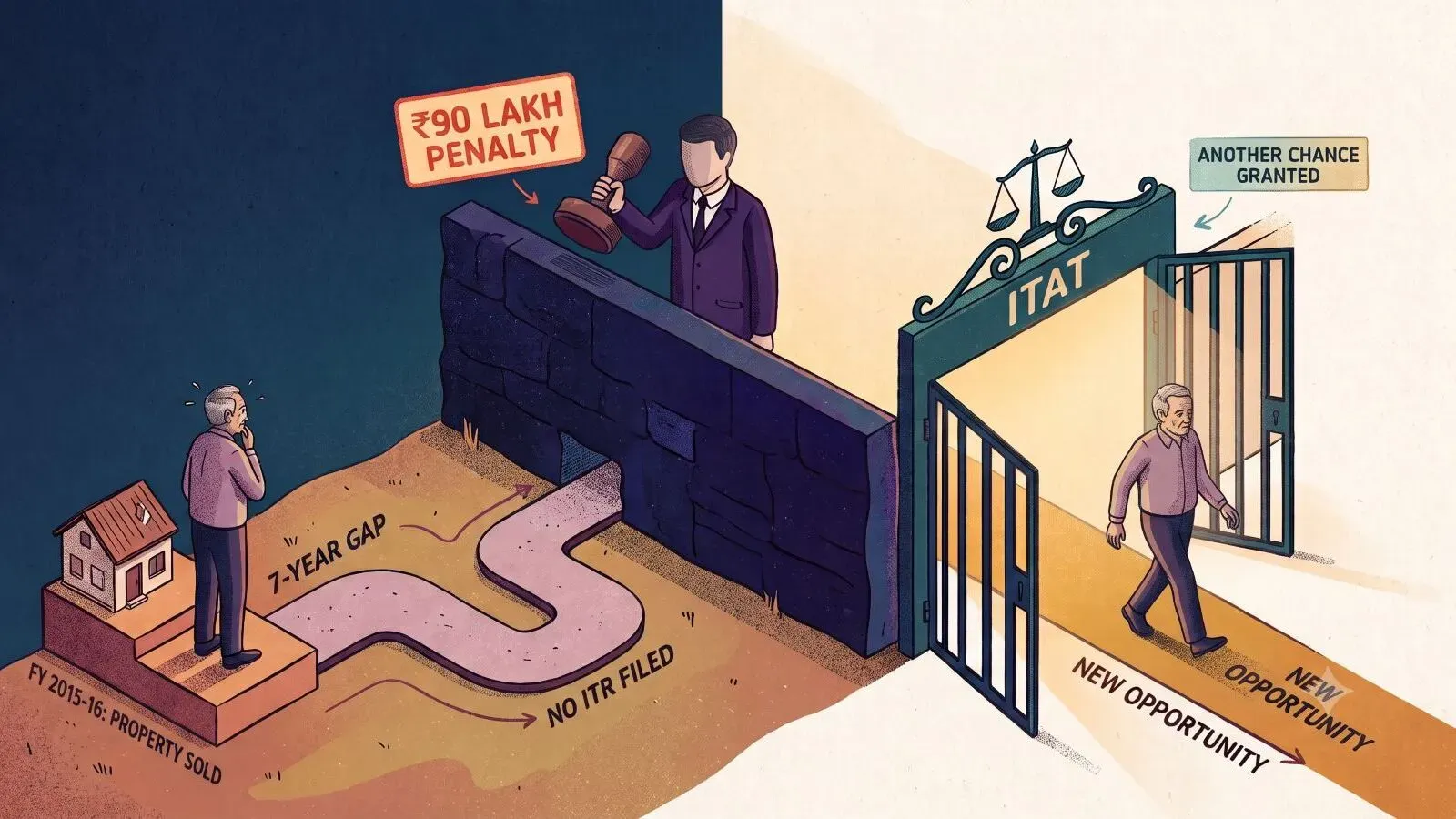
What happens if you sell a property but do not file your income tax return (ITR)? A recent case shows that while the tax department can impose hefty penalties, the Income Tax Appellate Tribunal (ITAT) may still give taxpayers a second chance if they explain their delay properly.
- Buyer deducts Tax Deducted at Source (TDS) on property sale, alerting tax authorities.
- Not filing an ITR after the sale can trigger reassessment and penalties.
- Tax officers can reopen cases even after several years.
- Delays in filing appeals may be condoned if there is a reasonable cause.
- ITAT can order fresh hearings rather than dismissing cases outright.
Why did the tax department penalize the property seller?
The tax department learned that Mr. Masurkar sold an immovable property in the financial year 2015-16. The buyer deducted TDS under section 194-IA, which means the transaction was reported to tax authorities. However, Masurkar did not file his income tax return for the assessment year 2016-17.
Seven years later, in February 2023, the assessing officer issued a notice to reopen the case under section 148. Despite multiple notices and opportunities to respond, Masurkar did not comply or submit explanations.
The tax officer then assessed Masurkar's income by adding short-term capital gains of ₹2.65 crore and interest income of ₹1.14 thousand. A penalty of over ₹90 lakh was also imposed in September 2024 for failure to file the return.
What was Masurkar's defense before the ITAT?
Masurkar appealed against the penalty and assessment, but the Commissioner of Income Tax (Appeals) rejected his appeals due to unexplained delay. At the ITAT, his counsel argued that the delay was not intentional but caused by circumstances beyond his control.
The ITAT noted that non-compliance can happen for various reasons and accepted Masurkar's request for condonation of delay, as explained in his Form 35 filing.
What legal principles did the ITAT apply?
The tribunal referred to Supreme Court rulings that encourage a liberal and justice-oriented approach to condoning delays in filing appeals. Specifically, the ITAT cited the case of B. Madhuri Goud v. B. Damodar Reddy, which emphasizes fairness over strict procedural rules.
The ITAT found that Masurkar had a reasonable cause for the delay and that no benefit was gained by delaying the appeal.
What is the final outcome of the case?
The ITAT did not cancel the penalty or assessment outright. Instead, it remitted the case back for fresh adjudication, giving Masurkar a fair chance to present his case with adequate hearings.
What lessons can property sellers learn from this case?
First, when a buyer deducts TDS on property sale, the transaction is on the tax department's radar. Sellers must file their income tax returns timely to avoid reassessment and penalties.
Second, if you miss appeal deadlines, you may still get relief if you can show sufficient cause for the delay. However, this only restores the hearing opportunity, not the final outcome.
Overall, staying compliant and responding promptly to tax notices is crucial to avoid costly penalties and lengthy legal battles.