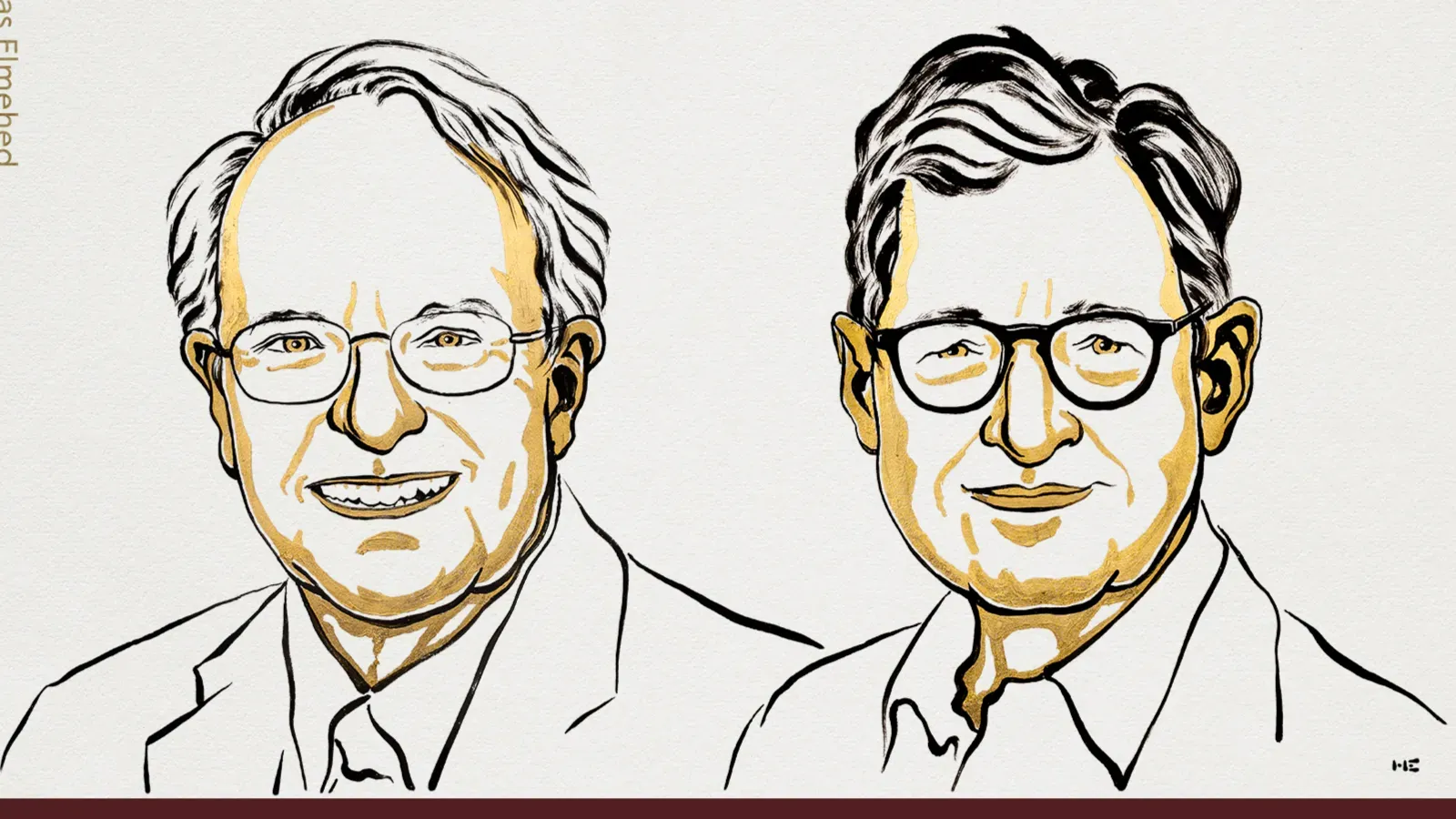
US economists Robert E. Hall and Michael Woodford won the 2026 Nobel Prize in Economic Sciences for developing macroeconomic models that improve how governments and central banks stabilize economies using monetary and fiscal policy. Their work has provided a stronger foundation for economic policy decisions worldwide.
- Robert Hall and Michael Woodford received the 2026 Nobel Prize in Economic Sciences.
- They developed models linking individual decisions to overall economic stabilization.
- Their work helps central banks and governments manage inflation, unemployment, and growth.
- The prize includes 12 million Swedish kronor, shared equally between them.
What did Hall and Woodford contribute to economics?
Hall and Woodford created macroeconomic models based on the "microeconomic foundations of macroeconomic stabilization." This means they focused on how individual households and businesses make decisions about spending, saving, and pricing. Their models consider how these decisions affect the whole economy, especially during times of economic instability.
Why were these models needed?
During the 1970s, traditional Keynesian economic models struggled to explain and manage economic problems like high inflation, unemployment, and slow growth. These older models mainly used statistical relationships between economic variables but did not fully consider how people’s expectations and decisions influence the economy.
How do their models improve economic policy?
Their models show that households and businesses make forward-looking decisions. By understanding this, governments and central banks can communicate their policy plans clearly to influence expectations. This helps steer economic activity more effectively, reducing fluctuations in output and employment caused by shocks to the economy.
What impact does this have on monetary and fiscal policy?
Monetary policy involves controlling interest rates and money supply, while fiscal policy involves government spending and taxation. Hall and Woodford’s work helps policymakers decide when and how to adjust these tools to stabilize the economy. Their models provide a reliable theoretical foundation that central banks and governments worldwide now use to guide their decisions.
Who are Robert Hall and Michael Woodford?
Robert Hall was born in 1943 in Palo Alto, California. He earned his PhD from the Massachusetts Institute of Technology (MIT) in 1967 and is a professor at Stanford University. Michael Woodford was born in 1955 in Chicopee, Massachusetts. He received his PhD from MIT in 1983 and teaches at Columbia University.
What is the Nobel Prize in Economic Sciences?
The Nobel Prize in Economic Sciences, officially called the Sveriges Riksbank Prize in Economic Sciences in Memory of Alfred Nobel, is awarded annually by the Royal Swedish Academy of Sciences. It recognizes outstanding contributions to the field of economics. The 2026 prize carries an award of 12 million Swedish kronor, which Hall and Woodford will share equally.
Frequently Asked Questions
Q: What are macroeconomic models?
A: Macroeconomic models are tools economists use to understand and predict how the overall economy behaves, including factors like inflation, unemployment, and economic growth.
Q: How do expectations influence the economy?
A: When people expect certain policies or economic conditions, they adjust their spending and saving decisions accordingly, which can affect economic outcomes like inflation and growth.
Q: Why is it important for policymakers to communicate their intentions?
A: Clear communication helps shape public expectations, making economic policies more effective in stabilizing the economy.