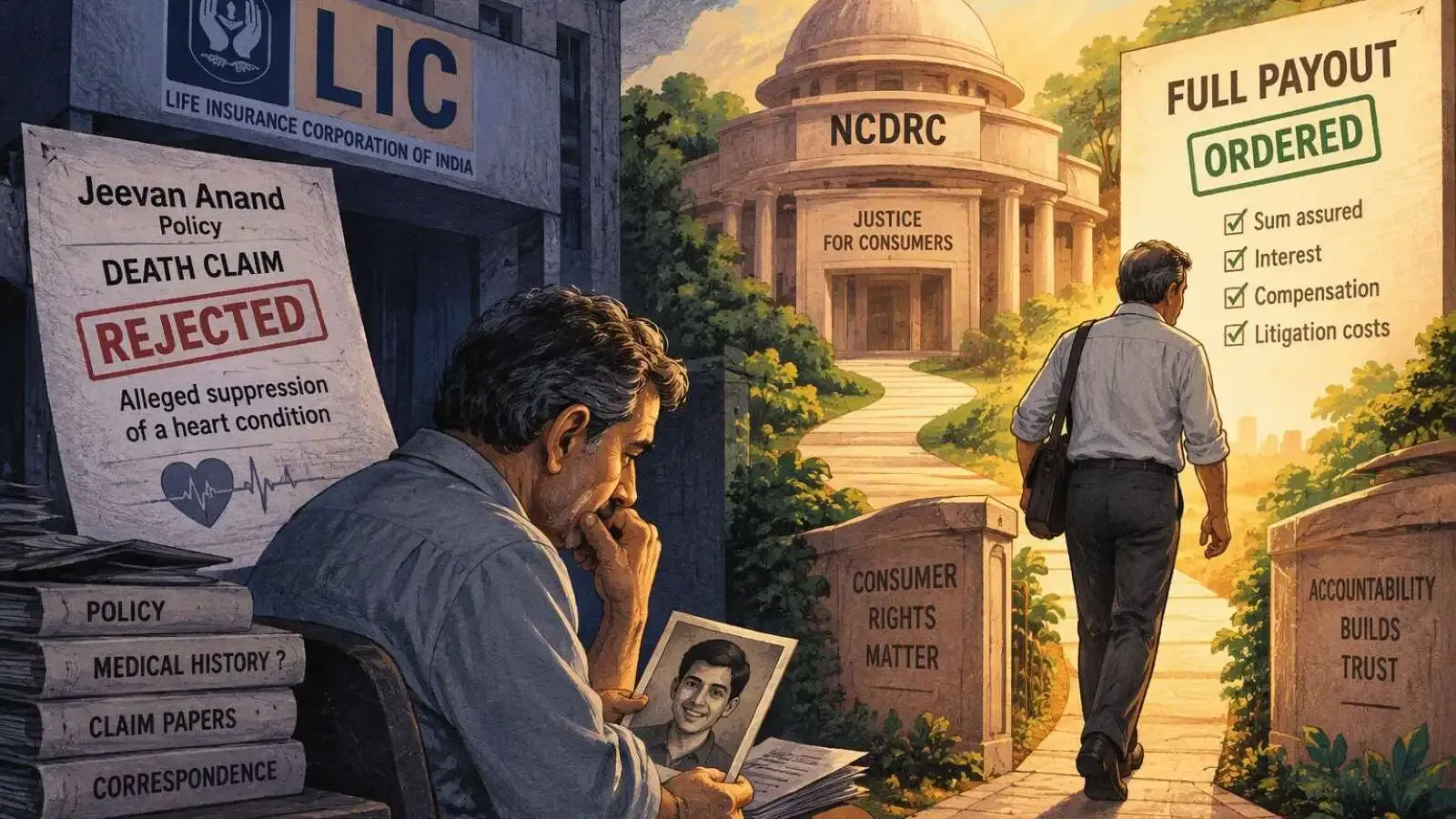
The National Consumer Disputes Redressal Commission (NCDRC) recently ordered the Life Insurance Corporation of India (LIC) to pay the full claim amount with interest to the nominee of a Jeevan Anand policyholder. LIC had denied the claim alleging suppression of a heart condition, but the NCDRC found no evidence that the deceased knew about the disease before submitting the proposal. This ruling highlights important points about insurance claims and disclosure requirements.
- LIC denied a ₹5,00,000 Jeevan Anand death claim citing alleged suppression of a heart condition.
- The deceased was diagnosed with hypertrophic cardiomyopathy shortly after submitting the proposal.
- The NCDRC ruled that diagnosis after proposal submission does not prove concealment.
- The insurer must prove the policyholder knew of the condition and deliberately hid it.
- Paperwork such as proposal forms, medical exams, and premium receipts are crucial evidence.
What was the background of the LIC Jeevan Anand claim case?
Navitesh Sadhwani took a Jeevan Anand policy in 2007 for ₹5,00,000 with an annual premium of ₹31,818. His father, Prakash Sadhwani, was the nominee. Navitesh also held another policy since 2006. He was hospitalized in October 2008 and died due to hypertrophic cardiomyopathy and related heart failure. The family filed a claim for the Jeevan Anand policy, but LIC denied it, alleging the deceased had hidden his heart condition.
Why did LIC deny the claim?
LIC argued that the proposal was submitted on February 7, 2007, and that the deceased was diagnosed with hypertrophic cardiomyopathy on February 5, 2007. LIC claimed the policyholder knew about the heart condition before submitting the proposal but answered medical questions falsely. LIC invoked the principle of utmost good faith, which requires full disclosure of material facts.
What did the NCDRC find about the proposal submission and diagnosis dates?
The NCDRC found that the proposal form was actually completed and signed on January 31, 2007, along with the medical examination and premium payment. The diagnosis of the heart condition occurred on February 5, 2007, after the proposal was submitted. The court noted that any delay in inwarding the proposal by LIC was an internal matter and did not change the proposal date.
Did the deceased conceal his heart condition?
The NCDRC held that the mere fact that the disease was diagnosed shortly after the proposal submission does not prove fraudulent suppression. LIC failed to prove that the deceased knew about the condition and deliberately hid it. The court emphasized that the insurer must establish that the policyholder had the opportunity to disclose the disease and consciously chose not to.
What was the final decision of the NCDRC?
The NCDRC dismissed LIC's petition and ordered the insurer to pay the ₹5,00,000 sum assured with 9% interest from the date of repudiation, plus ₹1,00,000 for deficiency. If LIC fails to pay within six weeks, the amount will carry 12% interest per annum until paid. The ruling reinforces the importance of evidence such as proposal forms, medical exams, and premium receipts in insurance disputes.
What can policyholders and nominees learn from this ruling?
This case clarifies that a diagnosis made shortly after submitting an insurance proposal does not automatically mean the insured hid the condition. Insurers must prove knowledge and deliberate non-disclosure to deny claims. Maintaining a clear paper trail and timely disclosure are essential for protecting insurance rights.