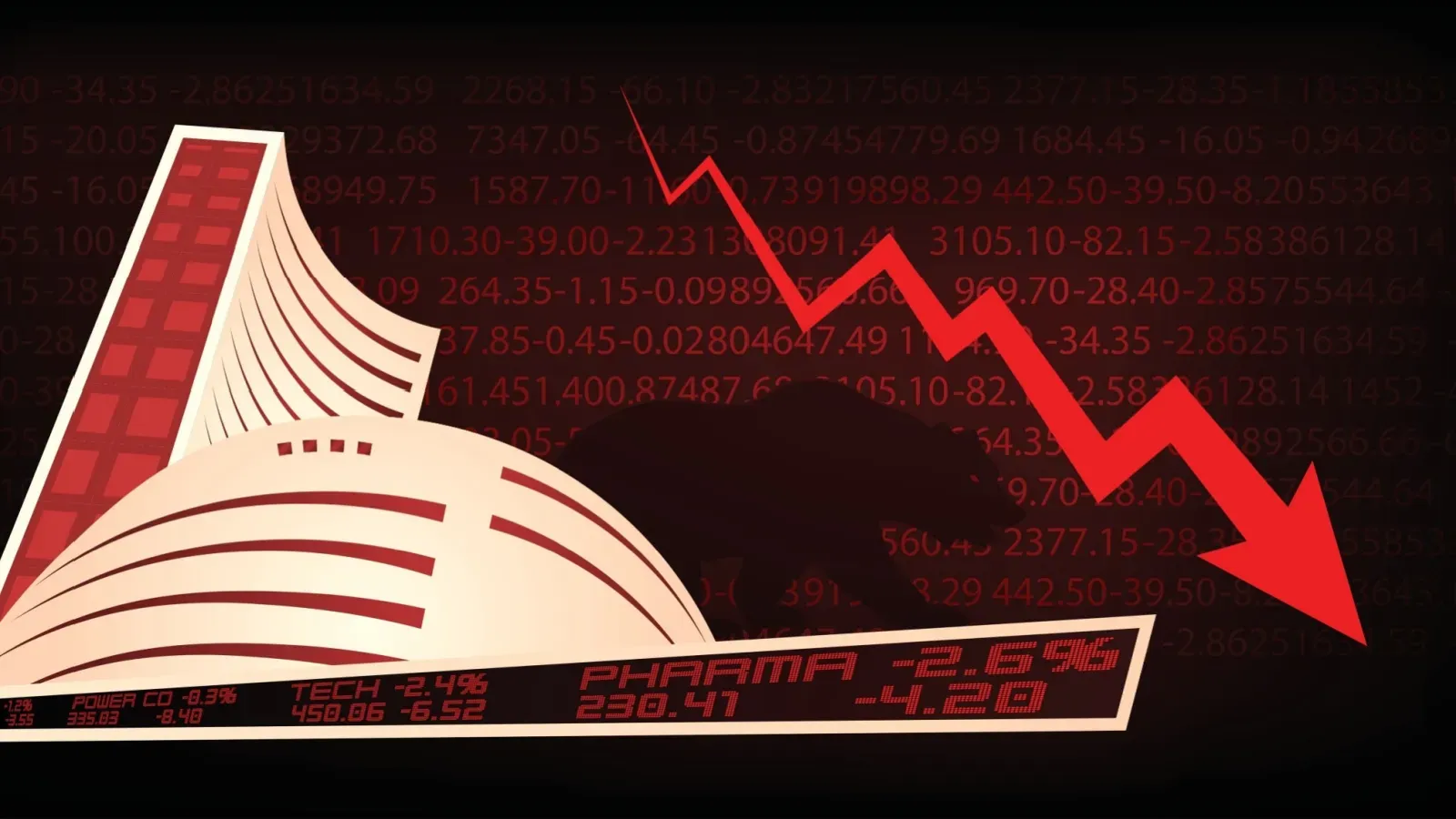
On October 22, 2026, the Indian stock market experienced a decline as the SENSEX closed at 73,249.39, down by 460.30 points or 0.62%, and the NIFTY50 ended lower by 123.70 points or 0.54% at 22,687.65. This drop was influenced by persistent selling pressure, weak global cues, and concerns over rising crude oil prices and geopolitical tensions.
- The SENSEX and NIFTY50 both declined amid negative global and domestic factors.
- Foreign institutional investors sold shares worth ₹3,458.70 crore, while domestic investors bought ₹2,891.32 crore.
- Nestle India and Eternal were among the top losers due to regulatory notices and market pressure.
- Bajaj Finance and Cipla were top gainers, showing resilience despite the overall market decline.
- Indian Hotels Company Ltd hit a 52-week high following strong quarterly results and upgraded revenue guidance.
Why did the Indian stock market decline on October 22, 2026?
The Indian equity benchmarks extended their losing streak to a third consecutive session due to persistent selling pressure and weak global cues. Crude oil prices remained high, with West Texas Intermediate (WTI) crude near $100 a barrel. Rising tensions between the US and Iran in West Asia raised concerns about supply disruptions, which in turn increased worries over inflation and the import bill.
The Indian rupee weakened to trade near 94.8 against the US dollar after gaining for eight straight sessions. Additionally, global markets, especially in Asia, experienced a broad sell-off, which negatively affected investor sentiment in India.
What role did institutional investors play in the market movement?
Foreign institutional investors (FIIs) sold shares worth ₹3,458.70 crore on October 22, contributing to the downward pressure on the market. In contrast, domestic institutional investors (DIIs) bought equities worth ₹2,891.32 crore, partially offsetting the selling by FIIs but not enough to prevent the overall decline.
Which stocks were the top losers and why?
Nestle India was among the top losers, closing 2.78% lower after the Food Safety and Standards Authority of India (FSSAI) issued notices to the company and Zydus Wellness. The notices concerned "misleading claims" in advertisements for certain products, including 'Lactogen Pro 1 Powder' and 'Nan Excella Pro Stage 1', and requested scientific proof to support these claims.
Other significant losers included Eternal (-2.53%), HDFC Life Insurance Company (-2.09%), Tata Motors PV (-2.07%), and Reliance Industries Ltd (RIL) (-2.03%).
Which stocks gained despite the market decline?
Among the top gainers were Bajaj Finance (1.74%), Cipla (1.29%), UltraTech Cement (1%), ICICI Bank (0.97%), and Bajaj Auto (0.82%). These companies showed resilience amid the broader market weakness.
Indian Hotels Company Ltd (IHCL) stood out by hitting a 52-week high. The company upgraded its consolidated revenue guidance for the financial year 2026-27 to 15-17%, up from the earlier 12-14%. IHCL also reported a 22.7% year-on-year increase in consolidated net profit to ₹349.49 crore for the July-September quarter, with revenue climbing 21.73% to ₹2,484.32 crore.
Other notable gainers included PB Fintech (2.97%), Aurobindo Pharma (2.03%), The Phoenix Mills (1.89%), and SBI Cards and Payment Services (1.50%).
How did midcap and smallcap stocks perform?
The NIFTY Midcap 100 index fell by 501.90 points or 0.87%, closing at 57,063.95. Top laggards in this segment included KEI Industries (-8.45%), Swiggy (-5.48%), Kalyan Jewellers India (-4.78%), Exide Industries (-4.19%), and Oracle Financial Services Software (-4.09%).
The NIFTY Smallcap 100 index also declined by 211.40 points or 1.14%, ending at 18,275.90. The biggest losers were Cupid (-6.38%), Gallantt Ispat (-5.88%), HFCL Ltd (-5%), Aarti Industries (-4.89%), and Sterlite Technologies (-4.85%). On the upside, Kaynes Technology India (4.08%), Sagility (2.21%), Acutaas Chemicals (2.14%), Pine Labs (1.98%), and Piramal Pharma (1.96%) were among the top gainers.