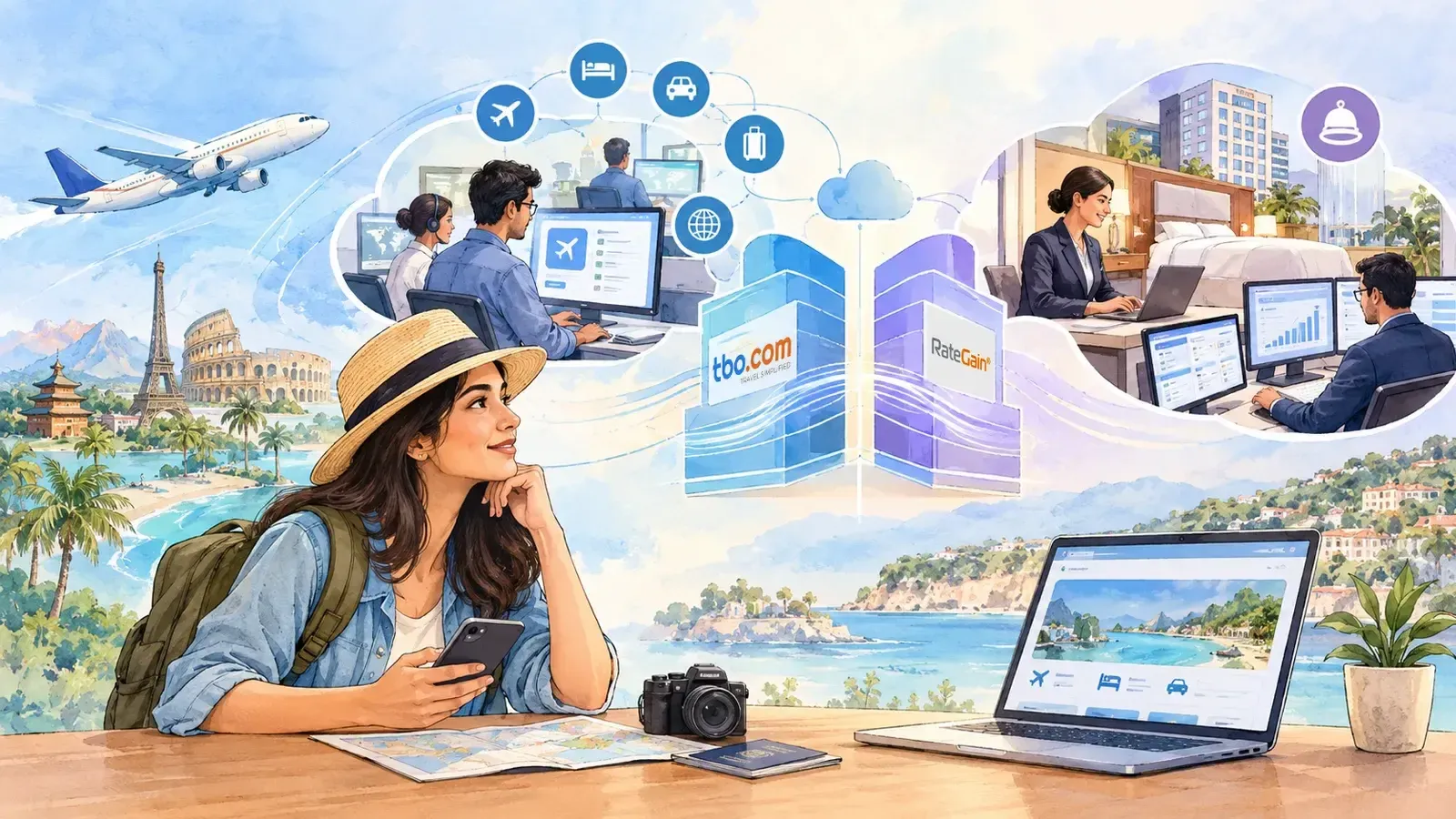
How do TBO Tek and RateGain power your travel bookings behind the scenes? These two Indian companies provide the essential technology infrastructure that connects travel suppliers and agents globally, making trip planning easier and more efficient for travelers and agents alike.
- TBO Tek offers access to over 1 million hotels and 750 airlines across approximately 150 countries.
- RateGain provides data-driven pricing, distribution, and marketing tools to hotels and airlines.
- Offline travel agents still hold about 55% of the booking market, highlighting their ongoing importance.
- Both companies have expanded through acquisitions to grow their global networks and capabilities.
- They are shifting toward AI-enabled platforms and outcome-based revenue models to improve service and profitability.
What role does TBO Tek play in the travel booking ecosystem?
TBO Tek acts as a business-to-business travel marketplace that connects travel agents with suppliers worldwide. Founded in 2006, it has evolved from an air-ticketing platform to a comprehensive service offering flights, hotels, transfers, sightseeing, cruises, rail, and car rentals. It also supports payments and foreign exchange to simplify cross-border transactions.
Its platform provides agents access to a vast inventory of over 1 million hotels and 750 airlines across roughly 150 countries. This extensive network allows agents to offer customized travel itineraries efficiently, even for complex multi-city or group trips.
Despite the rise of online booking, offline travel agents still control about 55% of the market. TBO Tek empowers these agents by giving them access to inventory and services that would be difficult to assemble independently. This helps agents remain competitive and meet customer needs effectively.
How does TBO Tek generate revenue?
TBO Tek earns commissions on airline tickets, though these are relatively low due to limited pricing flexibility by airlines. The company gains higher margins from hotel bookings and ancillary services by negotiating net rates with sellers and adding markups for buyers. This segment has grown significantly, with hotels making up 64% of gross transaction value in FY26, up from 45% in FY23.
The company has also expanded internationally, with about 60% of transaction value coming from outside India. Acquisitions such as Island Hopper, Gemini, Bookabed, Jumbonline, and Classic Vacations have strengthened its global supplier and buyer networks.
What services does RateGain offer to hotels and airlines?
RateGain helps hotels and airlines optimize pricing, inventory distribution, and marketing strategies. It offers three main services:
- Data and Pricing Intelligence (DaaS): Collects competitor prices, availability, and demand data to identify pricing gaps.
- Distribution: Automates real-time inventory, rates, and availability updates across multiple channels.
- Marketing Technology (MarTech): Provides tools to identify target audiences, run marketing campaigns, and measure their effectiveness.
These services are used by around 700 partners in over 160 countries, including 33 of the world's top 40 hotel chains.
How has RateGain evolved its business model?
Between FY23 and FY26, RateGain shifted its revenue mix by reducing reliance on DaaS and Distribution and increasing focus on MarTech services, which now account for 69% of revenue. It moved from fixed software subscription fees to a transaction-based model, earning revenue based on gross booking value, fee-per-transaction, or campaign success metrics. This approach aligns the company's earnings with client outcomes.
RateGain has also expanded through acquisitions, including BCV Social, MyHotelShop, Adara, and Sojern, which boosted its customer base from 3,224 in FY25 to over 14,000 in FY26. This growth has enhanced its ability to offer an integrated platform connecting demand generation, distribution, pricing, and guest engagement.
What challenges and opportunities lie ahead for these companies?
Both TBO Tek and RateGain face challenges such as travel industry downturns, geopolitical uncertainties, and changing customer behaviors. Their future growth depends on effectively leveraging their expanded capabilities and integrating new technologies.
TBO Tek is developing Voya, an AI-enabled platform to help travel advisors plan and manage complex itineraries more efficiently. RateGain aims to connect its technology stack to help hotels dynamically adjust prices, distribute inventory, and target guests through a unified system.
India's leisure and business travel booking market is expected to grow at a 7.74% compound annual growth rate from 2026 to 2032. Even as travelers increasingly use social media and AI assistants for planning, the need for robust inventory, pricing, distribution, and marketing infrastructure remains critical.
Frequently Asked Questions
Q: Why are offline travel agents still important?
A: Offline agents handle about 55% of travel bookings, especially for customized, group, or multi-city trips where personal assistance is valuable.
Q: How do TBO Tek and RateGain differ in their services?
A: TBO Tek connects agents with travel suppliers to provide booking inventory, while RateGain offers pricing, distribution, and marketing tools to hotels and airlines.
Q: What is the significance of acquisitions for these companies?
A: Acquisitions have expanded their global networks, customer bases, and service capabilities, enabling them to offer more integrated and comprehensive solutions.
In summary, TBO Tek and RateGain are key players in the travel industry's backend technology, supporting agents, hotels, and airlines to deliver seamless travel experiences worldwide. Their continued innovation and expansion will shape how travel bookings evolve in the coming years.