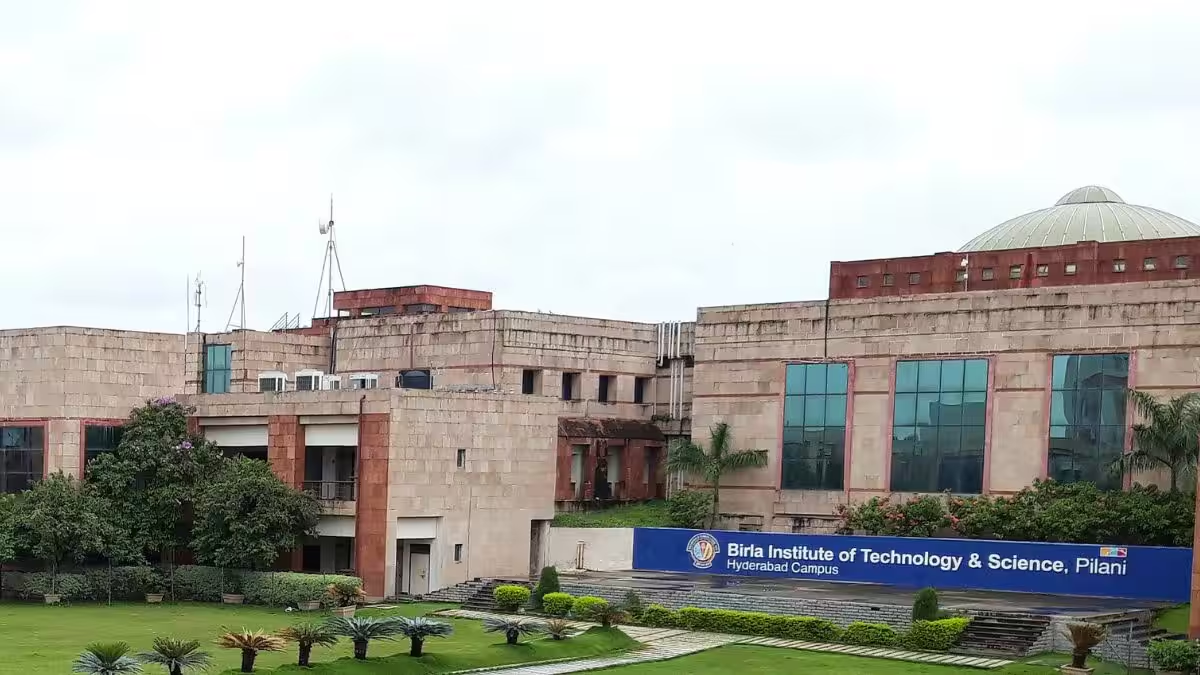
Ramgopal Rao, Vice Chancellor of the Birla Institute of Technology and Science (BITS) Pilani, has stressed that technology developed to meet Indian conditions has the potential to succeed worldwide. Speaking recently, Rao highlighted the unique challenges and opportunities India faces in becoming a global innovation hub, particularly in deep technology sectors that require longer development timelines.
Rao pointed out that India cannot rely solely on companies built around technologies created elsewhere. Instead, the country must foster innovation rooted in its own universities and research institutions, leveraging India’s vast talent pool and the scale of its domestic challenges.
Why India’s Homegrown Technology Matters
India’s innovation landscape is shaped by its distinct advantages: a large, skilled workforce and complex problems affecting millions. Rao believes these factors can drive the creation of globally significant companies if the focus remains on indigenous science and intellectual property. He identified critical sectors where India needs self-reliant solutions, including semiconductors, healthcare, agriculture, space exploration, energy, water management, advanced materials, artificial intelligence, defense, and manufacturing.
Unlike software products, which can be developed rapidly, deep technology ventures often require years of research, testing, certification, and significant investment before reaching customers. Rao explained that the journey from laboratory discovery to reliable product is the most challenging phase. He emphasized the importance of support from industry and government, especially through providing test environments and becoming early adopters of such technologies.
Key Facts About Deep Technology and BITS Pilani’s Role
- Deep technology startups face longer timelines than typical software startups, often requiring years before market entry.
- Early customers for deep tech products are often more valuable than initial investors, as they validate and support the technology.
- BITS Pilani is a leading institution fostering entrepreneurship, with 11 alumni founders featured in the Avendus Wealth-Hurun India U30 List 2026.
- The university offers flexible academic programs and a New Venture Creation course that guides students through the process of turning ideas into viable businesses.
- Students at BITS can pursue dual degrees across disciplines, such as engineering and chemistry, encouraging interdisciplinary innovation.
How BITS Pilani Is Shaping Future Innovators
Rao described BITS Pilani’s entrepreneurial culture as a decades-long effort now yielding results among young alumni. The institution encourages students to explore ideas beyond traditional coursework and provides structured support through mentorship and practical training. The New Venture Creation course immerses students in real-world entrepreneurship, covering customer engagement, competition analysis, technology validation, product development, finance, legal compliance, and fundraising.
Rao also stressed the need for Indian universities to develop a full innovation pipeline—from early research and patenting to prototype development, testing, certification, and industry collaboration. This comprehensive approach is essential to translate academic knowledge into economic and societal benefits, including new industries, quality jobs, manufacturing capabilities, exports, and strategic independence.
By enabling students to combine diverse fields such as computer science, chemistry, physics, biology, mathematics, and economics, BITS Pilani fosters the interdisciplinary thinking necessary for breakthroughs in areas like drug discovery and climate technology. Rao believes this broad academic exposure helps students identify opportunities that narrowly focused training might miss.
Frequently Asked Questions
Q: Why is deep technology development slower than software innovation?
A: Deep technology often involves complex research, testing, certification, and significant capital investment, which can take years before a product reaches the market, unlike software that can be developed and iterated quickly.
Q: What advantages does India have for becoming a global innovation hub?
A: India benefits from a large pool of talented individuals and the presence of large-scale challenges that can inspire innovative solutions with global relevance.
Q: How does BITS Pilani support student entrepreneurship?
A: BITS Pilani offers flexible academic programs, mentorship, and a New Venture Creation course that guides students through the entire process of developing and launching startups, emphasizing practical experience and interdisciplinary learning.