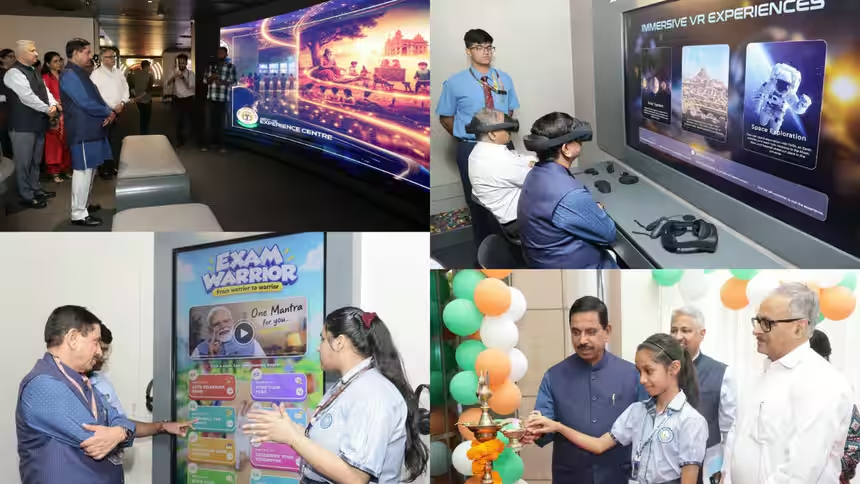
The CBSE Experience Centre was inaugurated by Union Education Minister Pralhad Joshi in Dwarka, New Delhi, with a focus on promoting experiential learning over rote memorization. Joshi highlighted concerns about the current education system's overemphasis on scoring marks, which often limits students' understanding and learning capacity.
- Students and parents are overly focused on marks, leading to rote learning.
- Experiential learning encourages deeper understanding and practical application.
- The CBSE Experience Centre showcases the evolution of education in India.
- The centre features 12 zones and 21 exhibits across 6,000 square feet.
- The initiative aligns with the National Education Policy 2020's goals.
Why does Minister Joshi criticize the focus on marks?
Minister Joshi pointed out that both students and parents have become "marks wadi," a term he used to describe their fixation on scoring marks. He explained that this mindset causes students to spend much of their time memorizing information just to perform well in exams, rather than truly understanding the material. This pressure can reduce students' confidence and leaves them with knowledge that is difficult to apply in real-life situations.
What is experiential learning and why is it important?
Experiential learning involves learning through experience and practical application, rather than memorizing facts. Minister Joshi emphasized that replacing rote learning with experiential learning can help students develop a deeper understanding of subjects, improve their problem-solving skills, and build confidence. This approach is a key part of the National Education Policy (NEP) 2020, which aims to make education more holistic and skill-based.
What does the CBSE Experience Centre offer?
The CBSE Experience Centre is located in the CBSE's integrated office complex in Dwarka. It covers 6,000 square feet and includes 12 broad zones with 21 exhibits. The centre takes visitors through the changing story of education in India, connecting ancient traditions with modern learning methods and new career opportunities. A special section is dedicated to the history of CBSE, featuring photographs and archival materials dating back to 1935. This section highlights the board's role in shaping the school education system over the years.
How does this initiative align with the National Education Policy 2020?
The National Education Policy 2020 encourages a shift away from rote memorization toward more experiential and application-based learning. Minister Joshi's call for reducing the focus on marks and promoting experiential learning reflects the NEP's goals. The CBSE Experience Centre serves as a practical example of this shift by providing interactive exhibits and educational experiences that foster understanding and engagement.
Frequently Asked Questions
Q: What is the main goal of the CBSE Experience Centre?
A: The main goal is to promote experiential learning and showcase the evolution of education in India, moving away from rote learning.
Q: Where is the CBSE Experience Centre located?
A: It is located at the CBSE's integrated office complex in Dwarka, New Delhi.
Q: How does experiential learning benefit students?
A: Experiential learning helps students develop a deeper understanding, improves problem-solving skills, and builds confidence by applying knowledge practically.