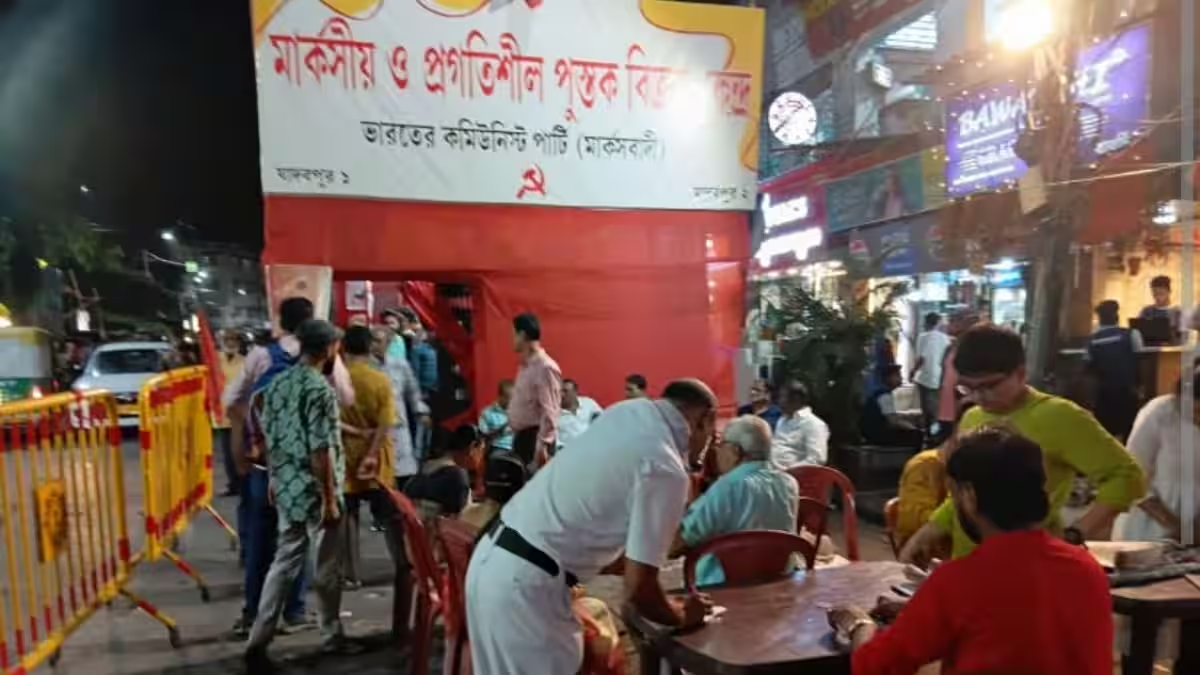
Bookstalls run by left-wing parties in Jadavpur, Kolkata, experienced a remarkable increase in sales this Durga Puja season after an attack on October 17 sparked a strong community response. The CPI(M) bookstall's sales rose from Rs 4 lakh last year to over Rs 16 lakh this year, as supporters rallied to defend the stalls and promote reading.
- Bookstalls at Durga Puja pandals are a longstanding tradition in West Bengal.
- The CPI(M) stall outside the Jadavpur pandal has operated for 40 years.
- On October 17, unidentified people attempted to dismantle bookstalls run by SUCI, AISA, APDR, and CPI(M).
- Community members, students, and party workers protected most stalls except SUCI’s.
- Following the attack, sales increased significantly, with customers buying books late into the night.
- The stalls offer a wide range of books, including Marxist, progressive, and classical Indian literature.
- People of all ages, from schoolgirls to nonagenarians, showed solidarity by purchasing books.
- The organisers complied with all municipal and police regulations to set up the stalls.
What caused the surge in bookstall sales at Jadavpur?
The surge in sales was a direct response to an attack on October 17, when unidentified individuals, allegedly supported by police and the BJP-led state government, tried to dismantle bookstalls run by left-wing groups during Durga Puja. The community’s defense of these stalls led to increased public interest and support, resulting in a fourfold rise in sales, especially at the CPI(M) stall.
How did the community respond to the attack?
Party workers, students, local residents, and supporters gathered to protect the stalls. Despite the attempt to dismantle them, the crowd grew large enough to prevent further damage. Many people visited the stalls late into the night to buy books as a form of protest and solidarity.
What kinds of books were sold at these stalls?
Although the CPI(M) stall is known as a centre for Marxist and progressive books, it stocked a diverse collection. This included works by Rabindranath Tagore, Bankim Chandra Chattopadhyay, Sarat Chandra Chattopadhyay, Sukumar Ray, Satyajit Ray, Mahasweta Devi, contemporary Indian authors, and translations of international literature.
Who visited the bookstalls during this period?
Readers of all ages visited the stalls, including schoolgirls buying books for the first time as a protest and elderly readers in their 80s and 90s showing solidarity. Visitors came from various parts of Kolkata and nearby areas like Howrah.
Did other bookstalls also see increased sales?
Yes, the All India Students’ Association (AISA) and the Association for Protection of Democratic Rights (APDR) also reported record sales during the Puja season. Both organisations noted that the public’s response was a stand against attempts to suppress their right to read and access books.
Were the bookstalls set up legally?
The organisers stated that they followed all required procedures, including paying the municipality and informing the local police. They questioned why the RSS-run bookstall was not subjected to similar dismantling attempts.
What message did the organisers share after the incident?
Jyotirmay Bakshi, a Left Front supporter and writer, said the incident showed how attempts to suppress knowledge can backfire. He compared the tactics used to those of historical dictators who tried to silence people. The organisers emphasized that the community’s strong response sent a clear message that bookstalls cannot be dismantled and that people will defend their right to read books of their choice.
Frequently Asked Questions
Q: Why were the bookstalls attacked during Durga Puja?
A: Unidentified individuals, allegedly supported by police and the BJP-led state government, attempted to dismantle bookstalls run by left-wing groups, possibly to suppress their political influence and the spread of progressive literature.
Q: How did the public react to the attack?
A: The public, including students, party workers, and local residents, rallied to protect the stalls and showed their support by buying books in large numbers, leading to a fourfold increase in sales.
Q: Are these bookstalls a common feature during Durga Puja?
A: Yes, bookstalls at Durga Puja pandals are a long-standing tradition in West Bengal, often run by political and cultural organisations.
Q: Did the organisers follow legal procedures to set up the stalls?
A: The organisers stated they complied with all municipal requirements and informed the local police before setting up the stalls.
Q: What types of books were available at the CPI(M) stall?
A: The CPI(M) stall offered a variety of books, including Marxist and progressive literature, as well as works by prominent Indian authors like Rabindranath Tagore and Bankim Chandra Chattopadhyay, and translations of international works.