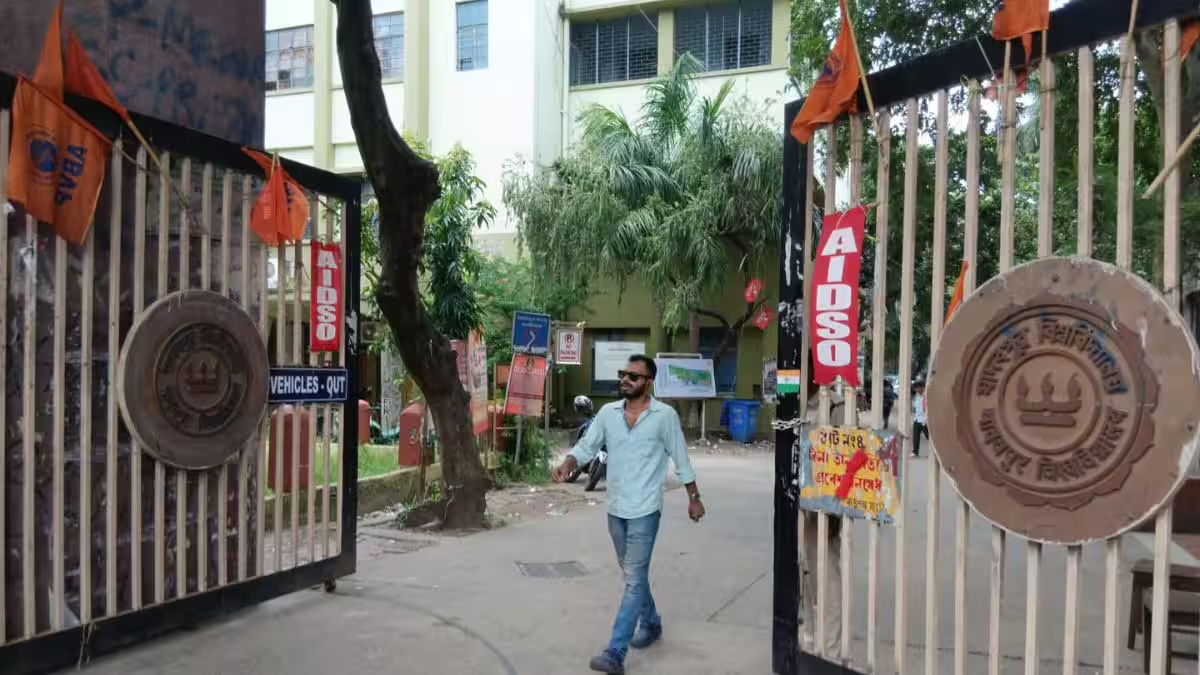
Former professors of Jadavpur University have expressed shock and disappointment following West Bengal Chief Minister Suvendu Adhikari’s recent comments accusing the campus of harboring anti-national elements. Adhikari vowed to instill nationalism within and beyond the university, targeting student groups he labeled as "tukde-tukde gangs" and ordering an investigation into alleged anti-national graffiti on campus. The CM’s remarks come amid escalating tensions after a violent clash between the BJP-affiliated student group ABVP and left-leaning student organizations.
Jadavpur University’s Historical Role in Nationalism
Jadavpur University’s origins are deeply intertwined with India’s struggle against colonial rule. Initially established as the Bengal Technical Institute during British rule, the institution was part of a broader nationalist effort to create an education system free from colonial control. Classes were often held in private homes linked to the freedom movement, and both students and faculty faced restrictions and risks of arrest for their activities.
Nilanjana Gupta, a retired English professor from Jadavpur, emphasized that the university’s foundation was a nationalist act itself. She highlighted stories of seven students sent abroad for advanced studies by the National Council of Education, Bengal, who returned to teach and build the university despite modest pay. Gupta questioned the Chief Minister’s understanding of nationalism, pointing out that the university’s history reflects a commitment to India’s independence and educational self-reliance.
Key Facts Behind the Current Controversy
- Chief Minister Suvendu Adhikari announced plans to promote nationalism at Jadavpur University and investigate anti-national graffiti on campus.
- The controversy follows a violent confrontation between ABVP and left-leaning student groups, during which the university’s emblem, designed by artist Nandalal Bose, was damaged.
- Former vice-chancellor Pabitra Sarkar refuted claims that "Vande Mataram" is not sung at university convocations, stating it has always been part of official ceremonies.
- Allegations that Jadavpur University restricts visits from education department officials were also challenged by Sarkar, who said university leaders regularly engage with government offices.
- The term "tukde-tukde gang," used by the CM to describe certain student groups, originated from a decade-old slogan at Jawaharlal Nehru University protests.
- There is a political dimension to the conflict, with ABVP seeking to expand its influence among West Bengal students where it has traditionally been weak.
Why This Debate Matters for Jadavpur and Its Students
The dispute over nationalism at Jadavpur University reflects broader political and cultural tensions in West Bengal and India’s academic institutions. Former faculty members warn that labeling students or the university as anti-national risks damaging its reputation and deterring prospective students. Nilanjana Gupta expressed concern that the controversy could discourage admissions, causing talented students to seek education elsewhere.
Another former professor criticized the idea of teaching nationalism as a formal subject, arguing that universities should foster critical thinking and independent thought rather than serve as ideological training grounds. He stressed that universities must remain spaces for new ideas and intellectual freedom, not just factories producing human resources.
The university itself has responded by setting up a panel to investigate the violence that erupted on August 20, signaling an attempt to address the unrest internally amid external political pressures.
Frequently Asked Questions
Q: What sparked the recent conflict at Jadavpur University?
A: The conflict began after ABVP, a BJP-affiliated student group, attempted to enter the campus, leading to clashes with left-leaning student organizations. The situation escalated with allegations of anti-national activities and damage to the university emblem.
Q: Has Jadavpur University historically promoted nationalism?
A: Yes, the university’s origins are linked to the nationalist movement against British colonial rule. It was founded as part of efforts to establish an independent education system, and patriotic songs like "Vande Mataram" have traditionally been part of official events.
Q: What impact could this controversy have on students?
A: The controversy may create an atmosphere of fear or hesitation among prospective students, potentially reducing admissions. It also raises concerns about academic freedom and the politicization of university campuses.