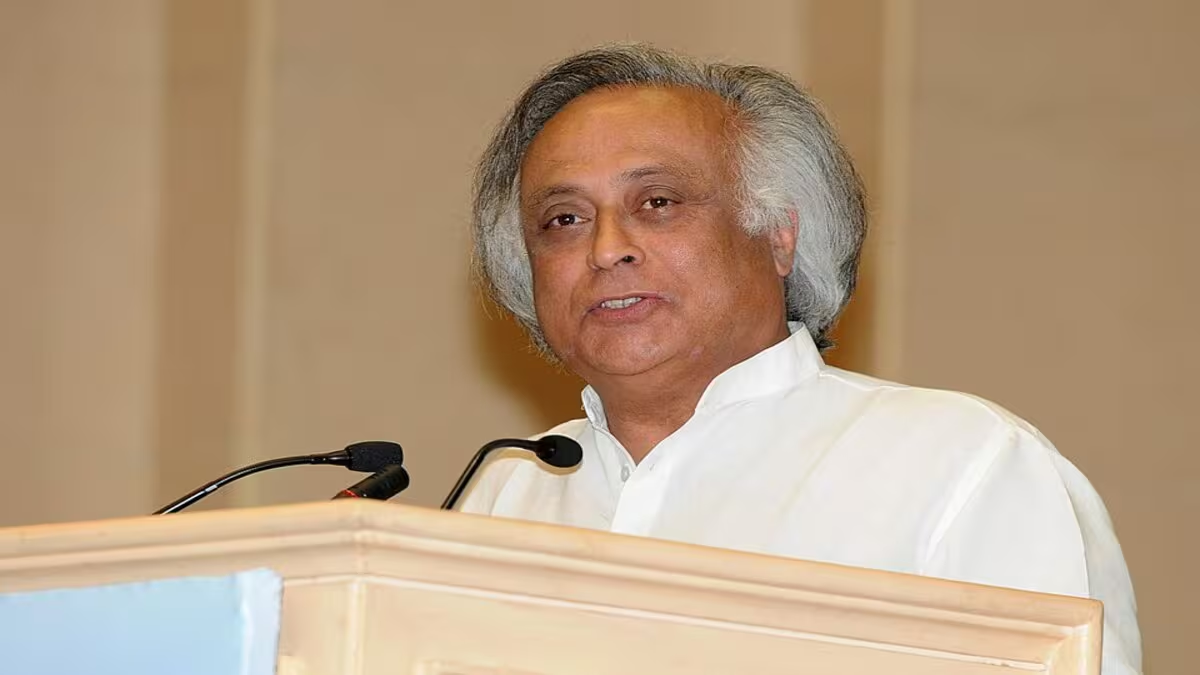
Senior Congress leader Jairam Ramesh has raised serious concerns about the National Testing Agency (NTA), focusing on its staffing shortages, operational transparency, and financial management. He referred to a parliamentary standing committee report that points out significant issues within the NTA and the education ministry.
- The NTA has only 39 sanctioned posts, with 41% currently vacant.
- All permanent posts are filled through short-term deputation, limiting expertise.
- The agency relies heavily on private contractors for exam administration.
- There have been allegations of nine paper leaks in NTA exams despite official denials.
- The NTA earned a revenue surplus of Rs 590 crore, which was invested rather than used for student support.
- NEET-UG results lack public accessibility and detailed data transparency.
What staffing issues does the NTA face?
The NTA has only 39 sanctioned permanent posts, but only 23 of these are currently filled, leaving nearly 41% of positions vacant. Furthermore, all these posts are filled through deputation, where officers serve only 2-3 years. This short tenure prevents the development of institutional expertise and continuity within the agency.
How does the NTA conduct its examinations?
The agency depends heavily on private contractors to conduct examinations. Jairam Ramesh described the NTA as a "khokhla body" because it delegates key responsibilities to these contractors. This structure lacks transparency and, according to Ramesh, facilitates malpractice such as paper leaks.
What are the allegations regarding paper leaks?
Despite the education ministry's claim that no paper leaks occurred from 2017 to 2025, Jairam Ramesh alleged that there have been nine paper leaks and irregularities in exams conducted by the NTA. He criticized the ministry for refusing to acknowledge these issues, questioning the possibility of fair investigations and accountability.
How transparent is the NTA with exam results?
The NTA does not publish NEET-UG results in a publicly accessible way. It also does not provide test-center wise data. This lack of transparency makes it difficult to detect unusual patterns in candidate performance or irregularities at test centers.
What financial concerns have been raised about the NTA?
Jairam Ramesh pointed out that the NTA has become a profit-making entity. It earned a revenue surplus of Rs 590 crore, which was invested in fixed deposits to generate interest. Instead of using these funds to improve exam infrastructure or assist students, the money remains unused for these purposes.
What recommendations has the parliamentary committee made?
The parliamentary standing committee on education has repeatedly recommended reforms, including creating a nationwide blacklist of firms that fail to provide reliable examination services. Currently, firms blacklisted in one state can still receive government contracts in others, which undermines accountability.
What is Jairam Ramesh's overall assessment?
Jairam Ramesh described the NTA as a "profit-making business" with serious shortcomings in staffing, transparency, and accountability. He emphasized the need for reforms to ensure fair investigations, improve institutional expertise, and enhance transparency in examination processes.