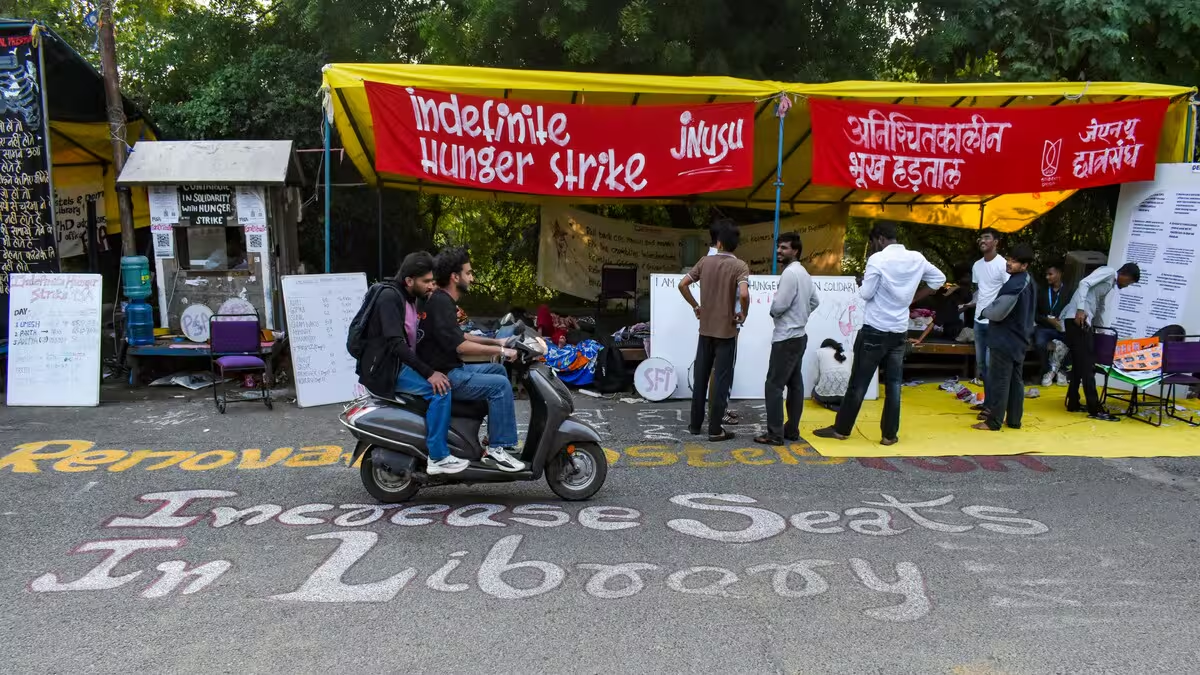
The Jawaharlal Nehru University Students’ Union (JNUSU) ended its 17-day hunger strike after the JNU administration agreed to meet several of their demands. The administration decided to withdraw First Information Reports (FIRs) filed against protesters and revoke the rustication of five student leaders. This decision marked a significant step toward resolving the ongoing conflict between students and the university authorities.
- JNUSU ended hunger strike after administration agreed to demands.
- Five rusticated students, including current and former student leaders, will be reinstated.
- FIRs against protesters will be withdrawn.
- Committees will be formed to review hostel reservations, entrance exams, and university policies.
- Scholarship amounts will be increased, and infrastructure audits will be conducted.
Who are the students whose rustication was revoked?
The JNU Vice-Chancellor, Santishree Dhulipudi Pandi, directed the immediate revocation of rustication for five students. These include Aditi Mishra, K Gopika Babu, Sunil Yadav, Danish Ali, and Nitish Kumar. The first four are current JNUSU office bearers, while Nitish Kumar is a former JNUSU president. Their reinstatement was a key demand during the hunger strike.
What other actions did the JNU administration agree to?
Besides revoking rustications and withdrawing FIRs, the administration agreed to withdraw proctorial inquiries related to protests against rustication, University Grants Commission (UGC) regulations, and hostel infrastructure issues. This move aims to ease tensions and foster dialogue between students and the university.
How will the university address policy and infrastructure concerns?
The university will form several committees to review and improve policies and infrastructure. One committee, including a JNUSU officer-bearer and an elected member, will examine the contentious clauses of the Campus Protection Office (CPO) manual and recommend changes. Another committee will review the JNU Entrance Examination (JNUEE) process with JNUSU representation.
An audit report on the Equal Opportunity Cell (EOC) will be provided within a week, and the cell will be reorganized in consultation with JNUSU office-bearers. Additionally, a panel will be formed to examine hostel reservations and the implementation of other demands.
What improvements are planned for scholarships and hostel facilities?
The administration agreed to consider a 25% increase in the Merit-cum-Means (MCM) scholarship to support students financially. Structural audits of the Tapti and Mahi-Mandavi hostels, as well as the Transgender and Gender Equality Facilitation Areas (TEFLAs), will be conducted. Renovation work will follow after these audits, ensuring better living conditions for students.
What are the next steps following these agreements?
The committee formed to address these issues will meet again after 14 working days to discuss the progress of specific demands and the procedures for their implementation. This ongoing dialogue aims to create a more supportive and transparent environment at JNU.
These developments show a commitment from both the JNU administration and the student union to resolve conflicts through dialogue and cooperation, focusing on student welfare and institutional improvements.