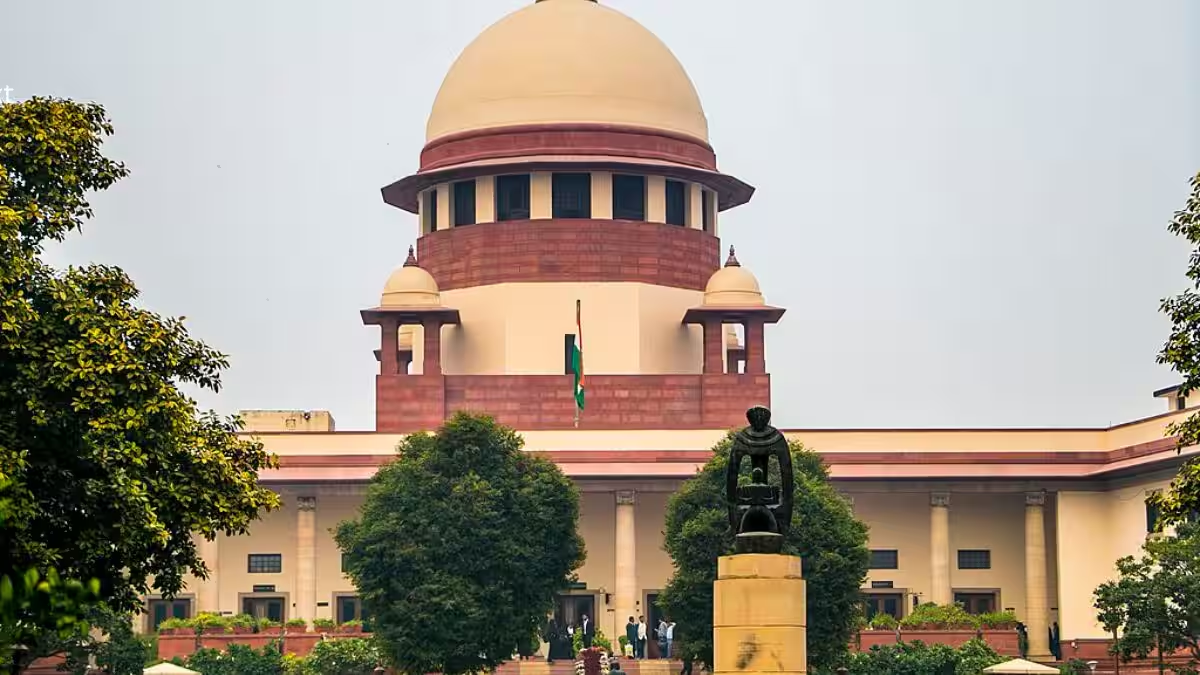
The Supreme Court of India has directed the central government to provide a detailed update on the implementation of reforms recommended for the National Testing Agency (NTA), the body responsible for conducting the NEET undergraduate medical entrance exam. This move comes amid concerns about exam security and the need for institutional improvements following a series of paper leak incidents.
The court emphasized the importance of embedding these reforms into the system to ensure the smooth and secure conduct of entrance examinations in the future.
Why the Reforms Are Needed
The National Testing Agency has faced significant challenges, particularly after the NEET-UG exam paper leak in 2024. To address these issues, the Ministry of Education set up the seven-member Radhakrishnan Committee to recommend changes aimed at improving exam security, data protection, and the overall functioning of the NTA. Alongside this, a high-powered task force led by Infosys co-founder Nandan Nilekani was established to suggest structural reforms leveraging advanced technology.
The Supreme Court pointed out that while recommendations exist on paper, their practical implementation has been inconsistent. The bench highlighted the need for the NTA to develop institutional memory and expertise, similar to the Union Public Service Commission (UPSC), which has built a robust system over decades by conducting exams regularly.
Key Measures and Safeguards in Place
- The NEET question papers are created by multiple moderators who prepare a large question bank, ensuring no single person controls the final exam content.
- Printing of question papers occurs under strict surveillance with CCTV and Central Industrial Security Force (CISF) protection.
- Transport of exam papers is secured with police escorts and GPS tracking to prevent tampering.
- On exam day, question papers are opened at centers in the presence of officials and students, with the process video recorded to maintain transparency.
- The NTA is exploring the use of advanced technologies such as artificial intelligence and blockchain to enhance exam security further.
Why Institutionalising Reforms Matters
The Supreme Court stressed that reforms must be deeply embedded within the NTA’s operations rather than being temporary fixes. Institutionalisation means creating a system that retains experienced personnel and continuously upgrades its technological capabilities. Without this, the agency risks losing knowledge and repeating past mistakes.
The court’s comparison with the UPSC underscored how regular conduct of exams over time builds expertise and trust in the institution. The NTA, still relatively new, must evolve similarly to become a reliable and vibrant body capable of managing high-stakes exams like NEET.
The court has ordered the Secretary of the Ministry of Education to file an affidavit within three weeks detailing the steps taken to implement the Radhakrishnan and Nilekani committee recommendations, including timelines for future actions.
Frequently Asked Questions
Q: What triggered the Supreme Court’s intervention regarding NEET exams?
A: The intervention was prompted by repeated incidents of exam paper leaks and concerns about the National Testing Agency’s ability to conduct secure and fair examinations.
Q: What are the main recommendations of the Radhakrishnan Committee?
A: The committee suggested reforms focused on improving exam security, data protection, and strengthening the structure and functioning of the NTA, including the use of advanced technologies.
Q: How does the Supreme Court want the government to proceed?
A: The court has asked the government to institutionalise reforms, provide a detailed report on the implementation progress, and ensure the NTA develops the necessary infrastructure and expertise to prevent future exam breaches.