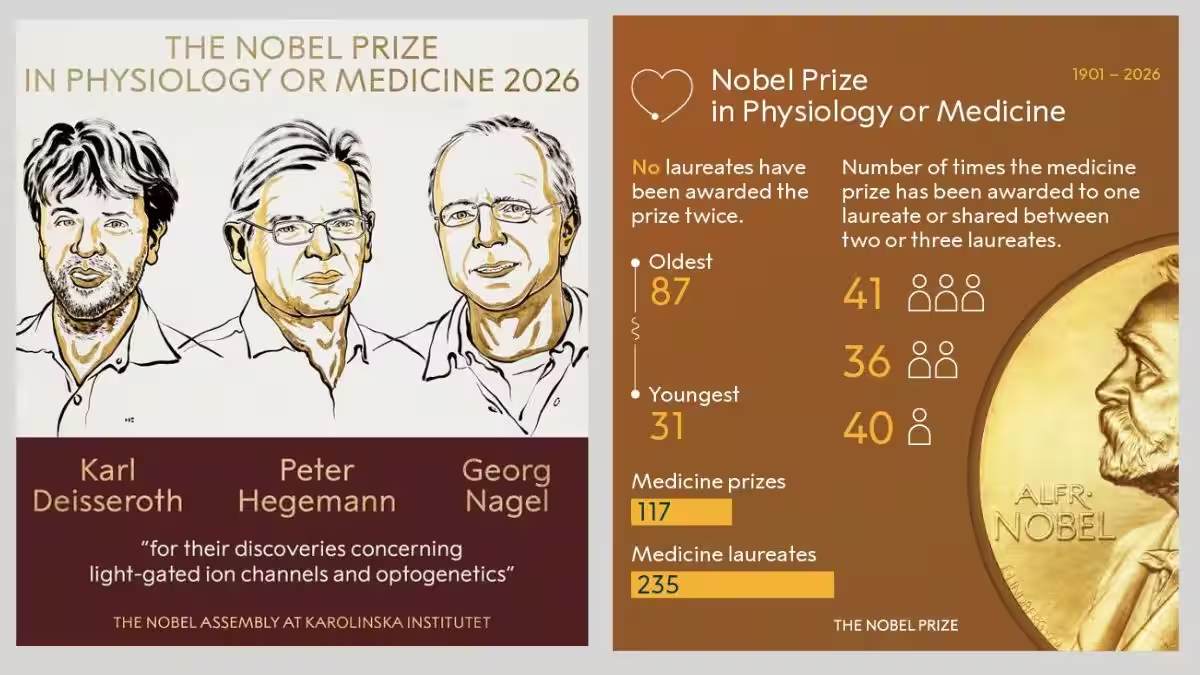
The 2026 Nobel Prize in Physiology or Medicine was awarded jointly to Karl Deisseroth, Peter Hegemann, and Georg Nagel for their groundbreaking research on light-gated ion channels and optogenetics. Their work allows scientists to switch individual nerve cells on or off in living brains, helping to understand how neural circuits affect memory, emotions, and behavior.
- Optogenetics uses light to control nerve cells in the brain.
- The technique helps reveal how brain circuits influence behavior and disease.
- Karl Deisseroth is based at Stanford University, Peter Hegemann at Humboldt University, and Georg Nagel at the University of Würzburg.
- The Nobel Prize in Medicine has been awarded 117 times since 1901.
- The 2026 prize includes 12 million Swedish kronor (about USD 1.2 million).
What is optogenetics and why is it important?
Optogenetics is a method that uses light to control nerve cells in the brain. It involves inserting light-sensitive proteins into neurons, allowing researchers to turn these cells on or off with precise timing. This technique opened a new era in neuroscience by enabling scientists to study how specific brain circuits work and how they relate to behavior and diseases.
How did the discovery of optogenetics begin?
The discovery started with Peter Hegemann's study of a single-celled green algae that swims toward light. Hegemann and Georg Nagel identified a protein that opens an ion channel when exposed to blue light, creating an electrical impulse. By inserting this protein into other cells, they made those cells responsive to light.
What role did Karl Deisseroth play in developing optogenetics?
Karl Deisseroth used the gene controlling the light-sensitive protein to create a light-controlled switch for nerve cells in the brains of living mice. This innovation allowed researchers to manipulate brain activity in real time, advancing the understanding of neural circuits and their effects on memory, emotions, and behavior.
Where are the Nobel laureates based?
Karl Deisseroth works at Stanford University in California, USA. Peter Hegemann is based at Humboldt University in Berlin, Germany, and Georg Nagel is at the University of Würzburg, also in Germany.
What is the significance of the Nobel Prize announcement?
The Nobel Prize in Physiology or Medicine is one of the most prestigious awards in science. Since 1901, it has been awarded 117 times to scientists who have made significant contributions to medical science. The 2026 prize highlights the importance of optogenetics in neuroscience research and its potential to unlock the mysteries of the brain.
How much is the Nobel Prize worth in 2026?
The 2026 Nobel Prize in Medicine carries a monetary award of 12 million Swedish kronor, approximately 1.2 million US dollars. This prize money is shared among the three laureates.
What other Nobel Prizes follow the Medicine Prize announcement?
The Medicine Prize announcement marks the start of Nobel Week. It is followed by the Physics Prize, Chemistry Prize, and the Literature Prize. Later, the Nobel Peace Prize is awarded, and finally, the Nobel Memorial Prize in Economic Sciences is announced, also with a prize of 12 million Swedish kronor.
Frequently Asked Questions
Q: What are light-gated ion channels?
A: Light-gated ion channels are proteins that open or close in response to light, allowing ions to pass through cell membranes and generate electrical signals in nerve cells.
Q: How does optogenetics help in neuroscience?
A: Optogenetics enables precise control of specific neurons using light, allowing researchers to study brain circuits and understand how they influence behavior and neurological diseases.
Q: Who are the 2026 Nobel laureates in Medicine?
A: The laureates are Karl Deisseroth from Stanford University, Peter Hegemann from Humboldt University, and Georg Nagel from the University of Würzburg.
Q: What is the prize amount for the Nobel Prize in Medicine 2026?
A: The prize amount is 12 million Swedish kronor, about 1.2 million US dollars, shared among the three winners.