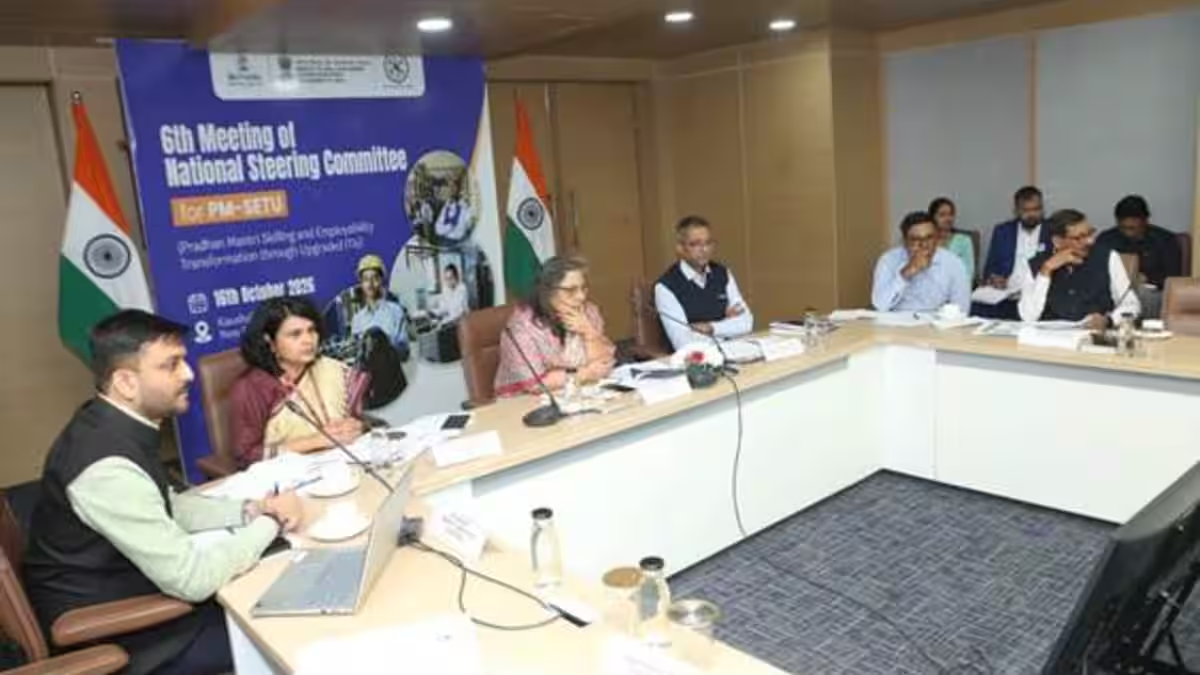
The Indian government has approved an investment of Rs 1,194.92 crore to upgrade five Industrial Training Institute (ITI) clusters across Maharashtra, Odisha, and Jammu and Kashmir. This funding is part of the Pradhan Mantri Skilling and Employability Transformation through Upgraded ITIs (PM-SETU) scheme, which focuses on improving vocational education and employment prospects for young people.
- The total sanctioned investment under PM-SETU has reached Rs 3,687 crore.
- Five ITI clusters in Maharashtra, Odisha, and Jammu & Kashmir will receive funding.
- Projects will modernize infrastructure, introduce industry-aligned training, and strengthen trainer capacity.
- Partnerships include Tata Steel Foundation, BVG India, Belrise Industries, Eagle Infra India, and Inderdeep Infra India.
- Training of Trainers (ToT) programme has trained 3,744 trainers as of October 2026.
What is the PM-SETU scheme and its purpose?
PM-SETU stands for Pradhan Mantri Skilling and Employability Transformation through Upgraded ITIs. The scheme aims to modernize Industrial Training Institutes by improving infrastructure, updating training programs to match industry needs, and enhancing the skills of trainers. This initiative helps young people gain relevant skills for better employment opportunities.
Which ITI clusters received investment approvals?
The National Steering Committee approved five Strategic Investment Plans across three states and union territories. The clusters and their approved investments are:
| ITI Cluster | State/UT | Industry Partner | Approved Investment (Rs crore) |
|---|---|---|---|
| Kataka ITI Cluster | Odisha | Tata Steel Foundation | 240.50 |
| Pune ITI Cluster | Maharashtra | BVG India Ltd and BVG Foundation | 241.00 |
| Chhatrapati Sambhajinagar ITI Cluster | Maharashtra | Belrise Industries Ltd | 238.01 |
| Jammu ITI Cluster | Jammu and Kashmir | Eagle Infra India Ltd | 240.00 |
| Srinagar ITI Cluster | Jammu and Kashmir | Inderdeep Infra India | 235.41 |
How will the Maharashtra ITI clusters benefit?
Maharashtra has two approved ITI cluster projects with a combined investment of Rs 479.01 crore. The Pune ITI cluster, partnering with BVG India Ltd and BVG Foundation, will have Government ITI Aundh as the hub and several spoke institutions including Government ITI Aundh (Women), Pimpri Chinchwad, Khed, and Mulshi.
The Chhatrapati Sambhajinagar ITI cluster, partnering with Belrise Industries Ltd, will have Government ITI Chhatrapati Sambhajinagar as the hub, supported by ITIs at Paithan, Khultabad, Phulambri, and Gangapur. These projects aim to improve training infrastructure and introduce programs aligned with industry skill requirements.
What upgrades are planned for the Odisha ITI cluster?
The Kataka ITI cluster in Odisha will receive Rs 240.50 crore in partnership with Tata Steel Foundation. Government ITI Kataka will serve as the hub institution, with spoke institutions including Madhusudan Government ITI Choudwar, Government ITI Paradeep, Jajpur, and Dhenkanal.
The project focuses on strengthening infrastructure, introducing new-age training programs, and building stronger links between ITIs and industries to meet emerging skill needs in the region.
What investments were approved for Jammu and Kashmir ITI clusters?
Two ITI clusters in Jammu and Kashmir received a total investment of Rs 475.41 crore. The Jammu ITI cluster, partnering with Eagle Infra India Ltd, will get Rs 240 crore with Government ITI Jammu as the hub and spoke institutions at R.S. Pura, Nowshera, Samba, and Kathua.
The Srinagar ITI cluster, partnering with Inderdeep Infra India, will receive Rs 235.41 crore. Government ITI Srinagar will be the hub, supported by ITIs at Ganderbal, Kangan, Budgam, and Charar-i-Sharief.
What progress has been made in training ITI trainers?
The National Steering Committee reviewed the Training of Trainers (ToT) programme under PM-SETU. As of October 2026, 3,744 trainers have been trained through National Skill Training Institutes. This program develops instructors with updated technical knowledge and teaching skills to provide industry-relevant training.
What are the expected outcomes of these investments?
According to Debashree Mukherjee, Secretary of the Ministry of Skill Development and Entrepreneurship, these investments will strengthen ITIs, improve training quality, and increase industry participation. The clusters are encouraged to pursue ISO certification and include WorldSkills-aligned trades to enhance training standards and employment opportunities for youth.
Overall, the PM-SETU scheme represents a significant step toward modernizing vocational education in India and equipping young people with the skills needed for the evolving job market.