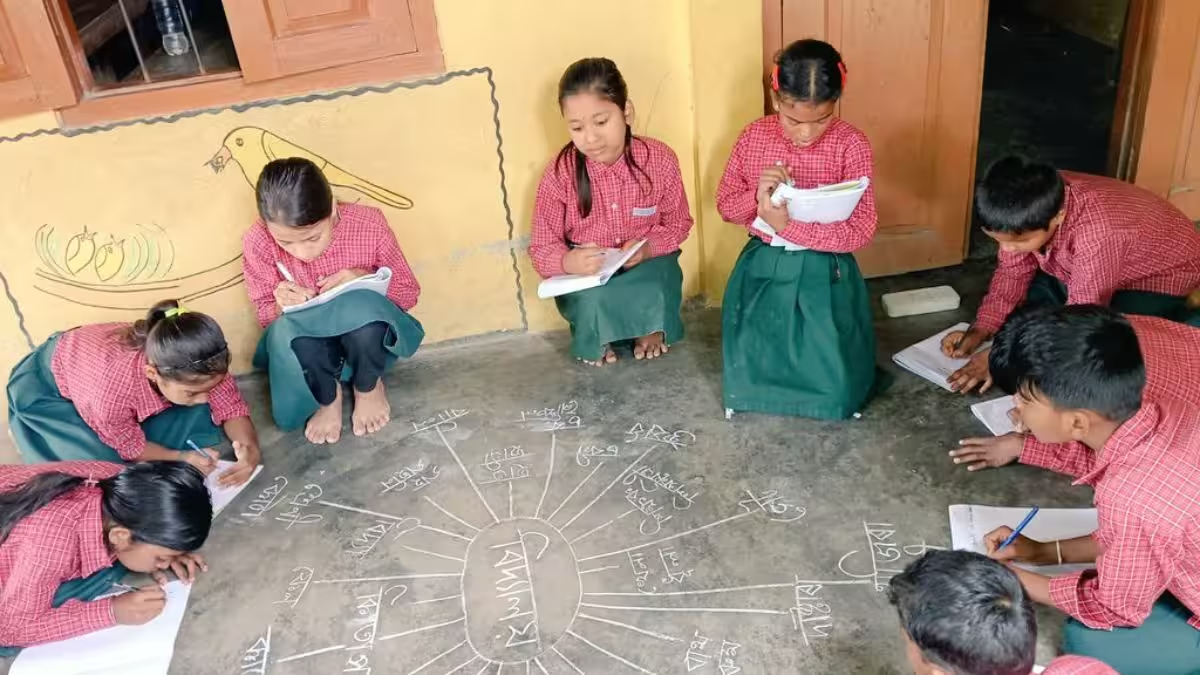
Over the past five financial years, the Indian central government has consistently released only around 80% of its allocated funds for the Samagra Shiksha Abhiyan (SSA), a flagship school education program. In the 2025-26 fiscal year, just 78% of the central share was disbursed to states. Meanwhile, the PM School for Rising India (PM SHRI) scheme saw an even larger shortfall, with nearly 49% of its funds withheld in 2025-26, according to data shared by the Ministry of Education in Parliament.
This information was disclosed by Minister of State for Education Jayant Chaudhary in response to a question from Congress MP S Jothimani during the current Lok Sabha session. The data highlights ongoing challenges in fund release and implementation of key education schemes across several states, including Kerala, Tamil Nadu, and West Bengal.
Understanding Samagra Shiksha and PM SHRI
Samagra Shiksha is an integrated scheme launched in 2018 that combines three earlier programs: Sarva Shiksha Abhiyan (SSA), Rashtriya Madhyamik Shiksha Abhiyan (RMSA), and Teacher Education. It covers school education from pre-school through class 12 and is funded jointly by the central and state governments, usually in a 60:40 ratio. Northeastern and hilly states receive a 90:10 split, while union territories without legislatures are fully funded by the centre.
The PM SHRI scheme, introduced in 2022, aims to transform select schools into model institutions aligned with the National Education Policy 2020. It targets over 14,500 schools, including Kendriya Vidyalayas and Navodaya Vidyalayas, focusing on infrastructure upgrades, technology integration, and modern teaching methods. The scheme has a total outlay of Rs 27,000 crore over five years, shared between the centre and states.
Key Funding Details and State Disparities
- Between 2021-22 and 2025-26, the central government withheld between 22% and 29% of its allocated Samagra Shiksha funds annually.
- In 2025-26, Rs 47,676.33 crore was allocated centrally for SSA, but only Rs 37,141.47 crore was released.
- States like Kerala, Tamil Nadu, and West Bengal received little to no central SSA funds in 2024-25 due to their refusal to sign memorandums of understanding (MoUs) linked to PM SHRI implementation.
- Kerala and Tamil Nadu received partial funds in 2025-26, with Kerala getting 22% and Tamil Nadu 38% of their central allocations.
- West Bengal consistently received a small fraction of its allocated funds, with only 18% released in 2023-24.
- PM SHRI funds saw even greater withholding: 52% in 2023-24, 39% in 2024-25, and 49% in 2025-26.
- States such as Bihar, Himachal Pradesh, Jharkhand, Odisha, Punjab, and NCERT-affiliated Kendriya Vidyalayas delayed or did not implement PM SHRI initially.
- Bihar received just Rs 5 crore out of Rs 600.45 crore allocated under PM SHRI in 2025-26, while Himachal Pradesh received full funds in 2024-25 but only about half in 2025-26.
Why Fund Withholding Matters for Education Quality
The consistent withholding of funds under Samagra Shiksha and PM SHRI has significant implications for the quality and equity of school education in India. These schemes are designed to support the fundamental right to education by improving infrastructure, teacher training, and learning outcomes across the country.
When states do not receive their full central share, planned activities such as school upgrades, teacher development, and resource provision are delayed or scaled back. This affects students’ learning environments and the overall progress toward national education goals.
Moreover, the linkage of SSA fund release to the PM SHRI scheme has created friction with some opposition-led states that have hesitated to sign MoUs, leading to uneven fund distribution. This politicization of education funding risks widening disparities between states and undermines the goal of universal quality education.
Experts warn that without timely and full fund disbursal, India’s efforts to implement the National Education Policy and improve school standards could face setbacks. Ensuring transparent, predictable funding is critical to sustaining reforms and supporting millions of students nationwide.
Frequently Asked Questions
Q: What is the Samagra Shiksha Abhiyan?
A: Samagra Shiksha is a comprehensive school education program launched in 2018 that integrates earlier schemes to cover education from pre-school to class 12. It is jointly funded by the central and state governments to improve access, quality, and equity in schooling.
Q: Why are some states not receiving full central funds?
A: Some states have not signed required agreements linked to the PM SHRI scheme, which has been tied to the release of Samagra Shiksha funds. Political disagreements and implementation delays have led to partial or withheld fund disbursal.
Q: How does withholding funds affect students?
A: When funds are withheld, schools may face delays in infrastructure improvements, teacher training, and resource availability, which can negatively impact the quality of education and student learning outcomes.