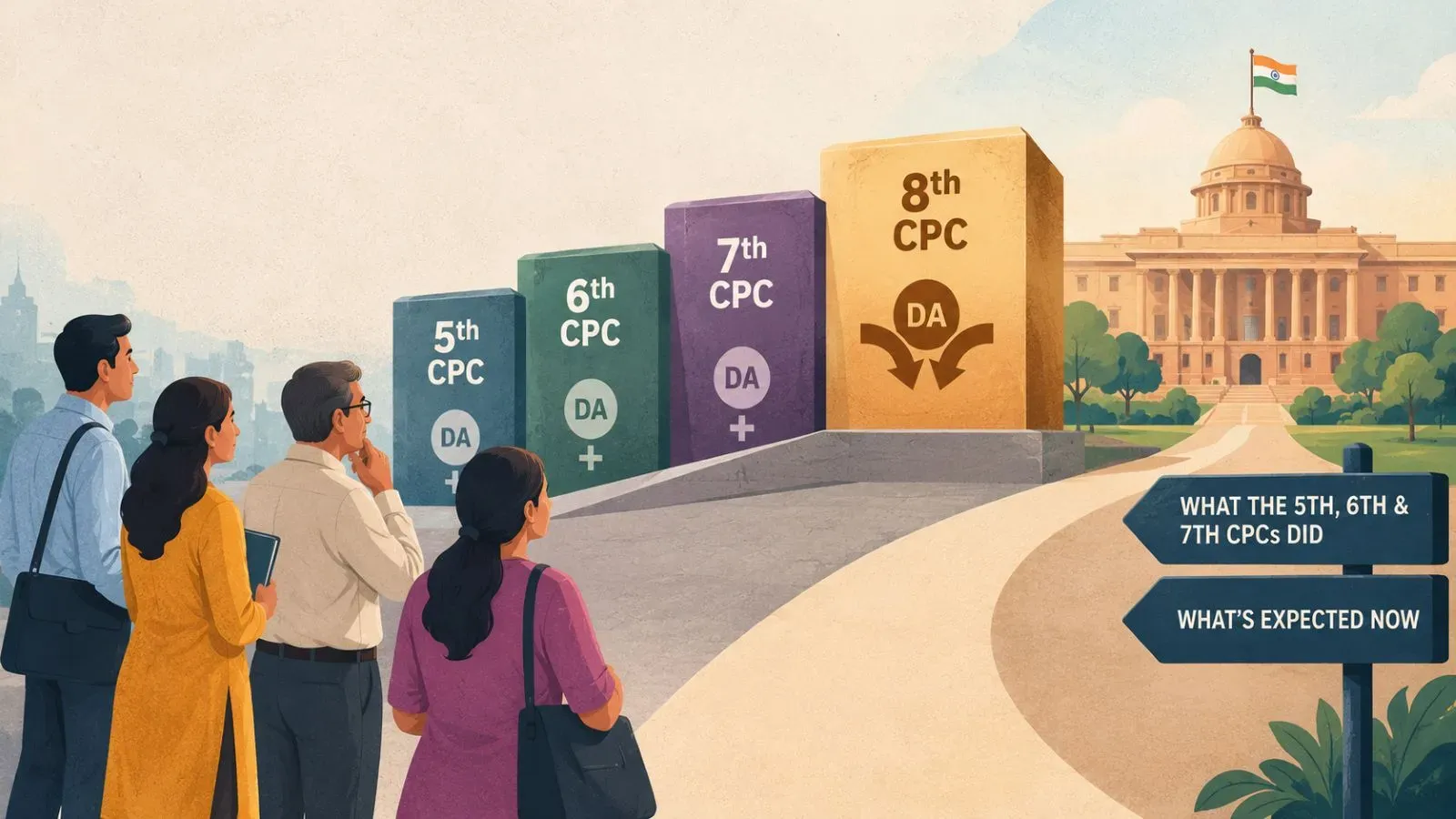
The 8th Pay Commission is expected to review the Dearness Allowance (DA) calculation method, which could change if it continues the approach of the 7th Pay Commission. DA is an important allowance given to government employees to offset inflation. This article explains what the previous pay commissions did about DA and what might happen now.
- The 5th Pay Commission used the 12-month average of the All India Consumer Price Index for Industrial Workers (AICPI-IW) with base year 1982 to calculate DA.
- The 6th Pay Commission updated the base year for AICPI-IW but did not support merging DA with basic pay.
- The 7th Pay Commission maintained the existing DA calculation method without changes.
- There are demands for quarterly DA revisions and merging DA with basic pay or pension.
- Some groups suggest revising the AICPI-IW formula to better reflect government employees' expenses.
What did the 5th Pay Commission decide about Dearness Allowance?
The 5th Pay Commission did not use separate indices for different employee categories because it was impractical. Instead, it recommended using the 12-month average of the All India Consumer Price Index for Industrial Workers (AICPI-IW) with the base year 1982 to calculate DA. This method provided a uniform way to adjust DA for inflation.
How did the 6th Pay Commission approach DA and its merger with basic pay?
The 6th Pay Commission revised the base year for calculating the AICPI-IW data but did not support merging DA with basic pay. It explained that converting DA into Dearness Pay should come with a revision of the base index. Since increments were calculated as a percentage of pay bands and grade pay, and allowances were linked to price index increases, the commission saw no need to merge DA with basic pay.
The 6th Pay Commission also rejected demands to revise DA quarterly, recommending it continue to be revised twice a year, on January 1 and July 1, for administrative convenience.
What was the 7th Pay Commission's stance on DA calculation?
The 7th Pay Commission found no reason to change the existing DA calculation method. It stated that the current formula had worked well over the years and there were no demands to alter it. Therefore, it recommended continuing with the existing formula and methodology for calculating DA.
What are the current demands and concerns regarding DA?
Several organizations have requested changes to the DA system. The Bharat Pensioners Samaj has asked for quarterly DA revisions based on three-month averages and for merging Dearness Relief with basic pension once it exceeds 25%.
Other groups suggest revising the AICPI-IW formula to consider a family unit of five instead of three, arguing that the current index does not fully reflect government employees' expenses. The Indian Railways Technical Supervisors Association (IRTSA) highlighted that the index does not cover government employees and that changes in calculation methods may reduce the average price index.
The Ministerial Staff Association and the Railway Senior Citizens Welfare Society have expressed concerns that the current DA mechanism does not fully meet the needs of modern families and only partially protects against inflation, leading to erosion of real wages and pensions.
What could happen with the 8th Pay Commission regarding DA?
If the 8th Pay Commission continues the 7th Pay Commission's approach, maintaining the status quo, changes in the AICPI-IW calculation methodology could still impact DA calculations. The commission may consider the demands for quarterly revisions, merging DA with basic pay or pension, and updating the price index to better reflect government employees' living costs.
Overall, the 8th Pay Commission's decisions on DA will affect how government employees' salaries and pensions keep up with inflation in the coming years.