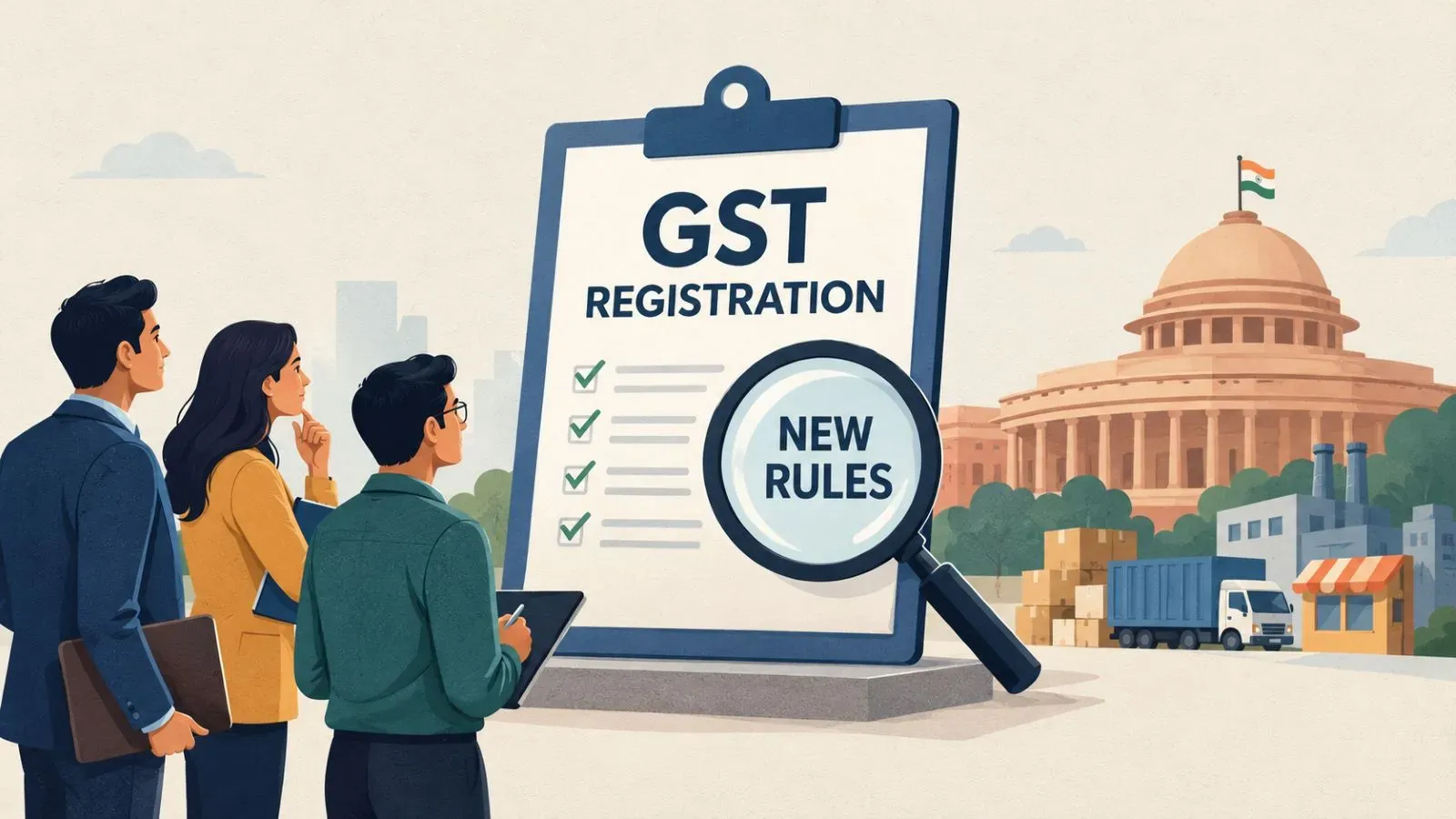
The Central Board of Indirect Taxes and Customs (CBIC) has released new GST registration guidelines in 2026 to make the process easier and faster for taxpayers and first-time applicants. These guidelines clarify deadlines, document requirements, and reduce unnecessary queries from tax officers, aiming to speed up registration for genuine applicants.
- Applications with Aadhaar authentication are processed within 7 working days.
- Without authentication, or if physical verification is needed, processing can take up to 30 days.
- Registration is automatically approved if no action is taken within the specified time.
- Small taxpayers can opt for simplified registration under Rule 14A with automatic approval in 3 working days.
- Notices for incomplete or inconsistent documents must be responded to within 7 working days.
- Tax officers should not ask for irrelevant documents like Udyam certificates or question residential addresses unnecessarily.
- Consent letters are required if the business premises are owned by someone other than the applicant.
- Photographs must be clear, individual, and not copies of identity cards.
- Bank details are required within 30 days after registration but not at the time of application.
- Applicants with suspended or cancelled registrations must clear pending returns before reapplying.
What are the new processing times for GST registration?
If an applicant completes Aadhaar authentication, the proper officer must process the application within seven working days. Without authentication, or if the application is flagged for physical verification, the process can take up to 30 days. In such cases, applicants may need to visit a Facilitation Centre for biometric verification and document checks, which must be completed within 15 days.
How does automatic approval work under the new guidelines?
The guidelines state that if the proper officer does not take any action within the time limits specified in the CGST Rules, the registration is deemed approved. The registration certificate (FORM GST REG-06) is then automatically available on the GST portal. This means that silence from the tax department now counts as approval.
Who can use the simplified registration under Rule 14A?
Small taxpayers who do not pass on input tax credit exceeding ₹2.5 lakh per month to registered buyers can use simplified registration under Rule 14A. This registration is granted automatically within three working days if the applicant uses Aadhaar authentication, has only one Rule 14A registration per state on the same PAN, and meets the tax credit limits. To switch to regular registration later, the taxpayer must have filed at least one return and cleared all pending returns.
What documents and responses are required during registration?
If a notice (FORM GST REG-03) is issued due to incomplete or unclear documents, or address mismatches, applicants must respond within seven working days using FORM GST REG-04. The officer then has seven working days to approve or reject the application with written reasons (FORM GST REG-05). This timeline ensures both applicants and officers act promptly.
What questions or documents should tax officers avoid requesting?
CBIC has instructed officers not to raise queries about the residential address of the applicant or signatories if it is in a different city or state. They should not demand Udyam or MSME certificates or question whether the business activities can be conducted from the declared premises. Officers must avoid asking for unnecessary documents or irrelevant queries.
How should applicants prove ownership or consent for business premises?
If the business premises are owned by a family member or partner, the applicant must upload a consent letter in the prescribed format along with an ownership document in the owner's name. If the property is co-owned, consent from all co-owners is required. Registered rent or lease agreements are accepted where mandated by law; otherwise, an agreement plus an ownership document or an undertaking with a utility bill may suffice. For co-working spaces, a membership agreement and proof of ownership or lease by the provider are needed.
What are the photo and signatory requirements?
Photographs must show the full front face of the individual applicant and must not be group photos or copies of identity cards. Uploading incorrect photos can lead to queries or rejection. Up to 10 authorized signatories can be named, each with a photo and authorization letter. It is recommended to name at least two signatories—a primary and an alternate—to ensure availability for e-sign or Aadhaar verification.
When must bank details be provided?
Bank details are not mandatory at the time of application but must be submitted within 30 days of registration or before filing details of outward supplies in FORM GSTR-1, whichever is earlier. Applicants can provide details of up to 10 bank accounts.
What must applicants do if their previous GST registration was suspended or cancelled?
Applicants must file all pending returns, including the final return (FORM GSTR-10), and clear any outstanding liabilities before applying for registration again.
What can applicants do if they face delays or unwarranted queries?
The circular advises applicants to file complaints with the jurisdictional Chief Commissioner of Central Tax or Commissioner of State Tax via a special email provided by the zone or state. This helps resolve issues related to delays or unnecessary queries.
These new guidelines, detailed in a 38-page circular, aim to onboard genuine businesses efficiently into the GST system by providing clear instructions and timelines for both applicants and tax officers.