Successful Return of Artemis II Crew after Lunar Mission
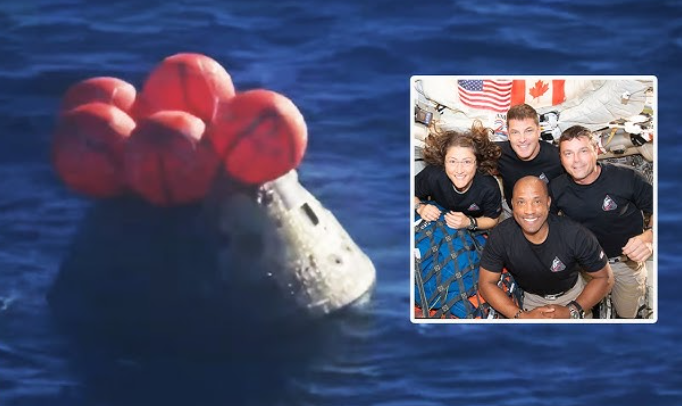
The crew of NASA’s Artemis II mission safely returned to Earth after orbiting the Moon for almost 10 days. The spacecraft, named ‘Integrity’, made a controlled landing in the Pacific Ocean near San Diego. It was a historic milestone, being the first crewed lunar flyby in over 50 years, paving the way for future space missions.
Challenging Re-entry and Safe Landing
During re-entry into Earth’s atmosphere, the spacecraft experienced intense heat and a plasma blackout, which temporarily blocked communication with mission control. Once past this phase, contact was re-established. The spacecraft deployed parachutes in stages: first stabilizing at 23,400 feet, then slowing further with three main chutes at 5,400 feet, resulting in a safe splashdown.
Important Facts for Exams
- Artemis II is NASA’s first crewed lunar mission since the Apollo era.
- The Orion spacecraft is built for deep space human exploration.
- Re-entry blackout happens because ionised plasma blocks radio signals.
- Mach speed is several times faster than the speed of sound.
Recovery and Significance of the Mission
After landing, NASA and US military teams recovered the capsule using inflatable rafts and US Navy helicopters, transporting the astronauts to the USS “John P. Murtha”. Medical checks were conducted onboard before they moved to NASA’s Johnson Space Center in Houston. This mission is vital for NASA’s Artemis programme, which aims to land humans on the Moon and explore Mars in the future.