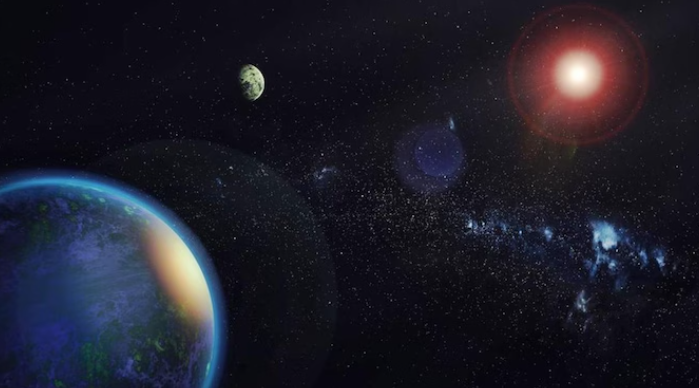
Discovery of Unique Solar System with Two Similar Planets
A novel planetary system has been identified approximately 120 light-years from Earth. It features two rocky planets similar in size and makeup to Earth. Such planets are called super-Earths, and their presence together is rare, providing scientists a chance to study their development under comparable conditions.
Unusual Planet Arrangement Challenges Existing Models
The system's structure is peculiar. Normally, rocky planets form nearer to the star, while gas giants are found farther away. But in this case, a rocky planet is located beyond the gas giants, which goes against traditional planetary formation theories. This suggests the system has a more intricate evolution than we previously thought.
Reevaluating Theories of Planet Formation
This discovery prompts scientists to think about new ways planets might form. One idea is the “inside-out” model, where planets could form or migrate differently than expected. Such cases hint that planetary formation varies based on factors like gravity, the composition of the protoplanetary disc, and activity of the star.
Important Facts for Exams
- Exoplanets are planets orbiting stars outside our Solar System.
- Super-Earths are planets larger than Earth but smaller than Neptune.
- Planetary formation typically occurs from protoplanetary discs made of gas and dust.
- Space telescopes like TESS and CHEOPS find exoplanets by observing light dips as planets pass in front of stars.
Role of Advanced Space Telescopes in Discoveries
The new findings come from data obtained by space missions such as NASA’s TESS and the European Space Agency’s CHEOPS. These telescopes detect distant planets by noticing tiny reductions in starlight during planetary transits. Such discoveries help scientists improve models of planetary formation and understand why some systems, including our own, might be unique.