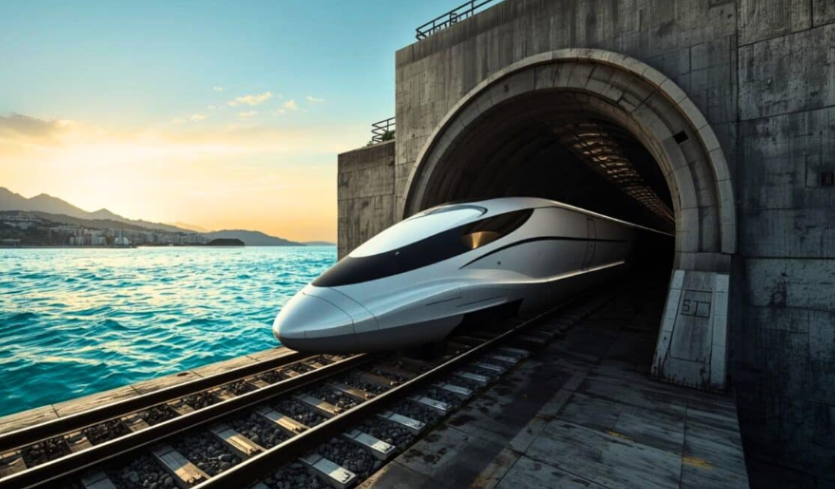
High-Speed Rail Under the Sea
China is developing a large-scale underwater tunnel beneath the Bohai Strait, linking the provinces of Liaoning and Shandong. The tunnel will support trains running faster than 250 km/h, drastically reducing travel time between Dalian and Yantai. Currently, travelers rely on ferries or lengthy routes around the sea, which take much longer.
Enhancing Regional Connections
The tunnel will connect Dalian, a major port and industrial city, with Yantai, an important maritime economic hub in Shandong. Replacing ferries with a fixed rail link aims to strengthen economic ties across the Bohai Rim region and improve movement of both passengers and freight within northern China’s high-speed rail network.
Engineering and Design Challenges
Constructing such a deep-sea tunnel involves complex engineering, such as managing seabed geology, fault lines, and seismic risks. The design will include artificial islands and vertical shafts for ventilation, emergency access, and construction. Environmental factors like seasonal ice and maritime traffic will also be carefully managed to ensure safety and durability.
Important Facts for Exams
- The Bohai Strait lies between the Liaodong and Shandong peninsulas in China.
- High-speed rail usually operates above 250 km/h.
- Subsea tunnels require sophisticated ventilation and safety features.
- The Channel Tunnel between the UK and France is one of the world’s longest existing subsea tunnels.
Project Status and Future Plans
The Bohai Strait Cross-Sea Channel is in the study phase, with ongoing assessments of environmental impact, route, and costs. The project will require significant investment, possibly hundreds of billions of yuan. Once completed, it will be among the longest undersea rail tunnels globally and a major achievement in infrastructure development.