Reevaluating the Galactic Center: Black Hole or Dark Matter?
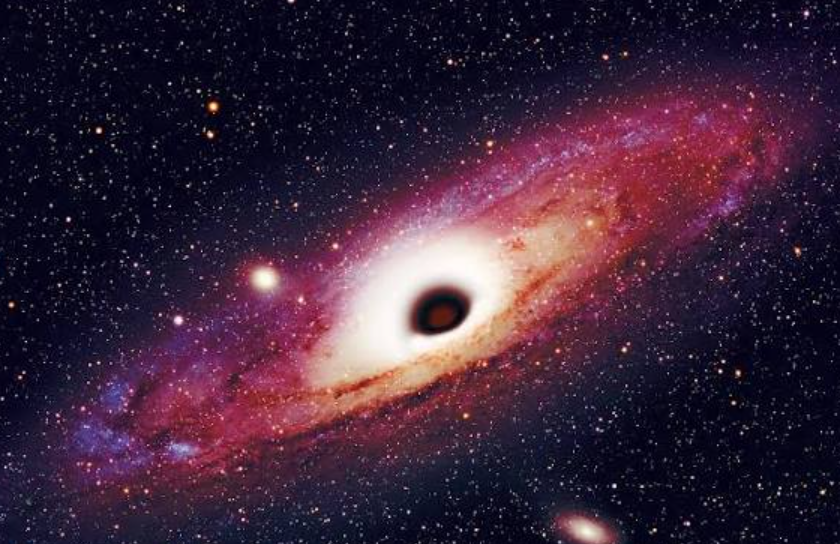
Traditionally, astronomers have believed that a supermassive black hole called Sagittarius A* exists at the centre of our galaxy, based on the rapid motion of nearby stars. These stars orbit extremely fast around the galaxy’s core, which suggested the presence of a massive object with intense gravitational pull, estimated to be about four million times the mass of the Sun.
Alternative View: Dark Matter as the Central Object
Recent studies propose an alternative explanation: instead of a black hole, the core might be a dense concentration of dark matter, made up of fermionic particles. Unlike black holes, this structure wouldn’t have a singularity or an event horizon. It would act as a dense mass capable of producing similar gravitational effects, with a dark matter halo extending outward to explain the galaxy’s movement patterns.
Impact on Understanding Star Movements
The orbiting stars close to the galaxy’s center, known as S-stars, have been key evidence supporting the black hole theory. However, the new model suggests that a dark matter core could cause their high-speed orbits as well, raising the possibility that current observations might be explained by different arrangements of matter, not necessarily a black hole.
Key Facts for Exams
- Sagittarius A* is located at the centre of the Milky Way.
- Dark matter cannot be seen and interacts mainly through gravity.
- S-stars are stars orbiting very rapidly near the galactic center.
- Gravitational lensing bends light around massive objects.
Implications for Astronomical Studies
Instruments such as the Event Horizon Telescope have observed ring-like images believed to be the shadow of a black hole. The new hypothesis suggests such rings could also form from intense gravitational lensing around a dense dark matter core. If this idea is proven true, it could dramatically change the current understanding of black holes and the distribution of matter in galaxies.