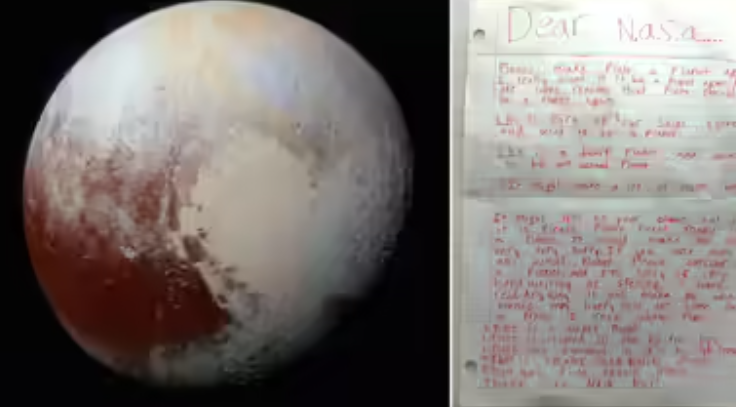
Background of Pluto’s Reclassification
Pluto was discovered in 1930 by astronomer Clyde Tombaugh and was popularly recognized as the ninth planet in our solar system. However, in 2006, the International Astronomical Union (IAU) set new rules for defining planets. Pluto did not meet one of these rules—specifically, its inability to clear its orbit—which led to its reclassification as a dwarf planet located in the Kuiper Belt.
Renewed Public Interest and NASA’s Response
The issue came back into the spotlight when a young student wrote to NASA asking for Pluto to be reinstated as a planet. The student’s letter included details about Pluto, such as its location, size, and moons. NASA's administrator Jared Isaacman responded by saying they are considering the request, which has sparked international curiosity and discussion.
Scientific Rules for Classifying Planets
The IAU states that a celestial object must meet three conditions to be called a planet: it must orbit the Sun, have enough mass to be round in shape, and have cleared its nearby area of other objects. Pluto meets the first two but shares its orbit with other objects in the Kuiper Belt, which is why it is classified as a dwarf planet.
Key Facts for Exams
- Pluto was reclassified as a dwarf planet in 2006 by the International Astronomical Union.
- Kuiper Belt is a region beyond Neptune filled with icy bodies and dwarf planets.
- Pluto has five known moons, including Charon.
- A planet must clear its orbital neighbourhood as per IAU rules.
Scientific and Educational Importance
The ongoing debate underlines how scientific classifications can change and highlights the importance of public participation in science. While any change in Pluto’s classification needs worldwide scientific agreement, this discussion shows how new discoveries help refine our understanding of the solar system.