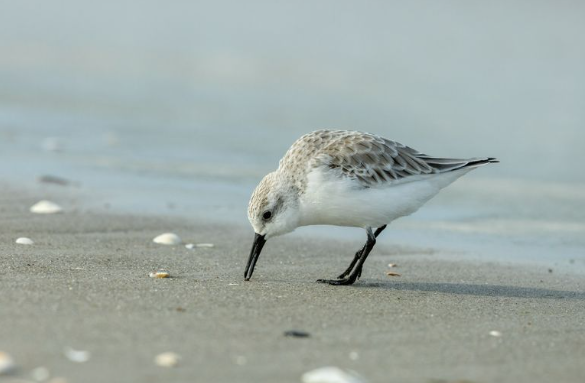
About the Sanderling
The Sanderling (scientific name: Calidris alba) is a small, rounded bird that wades along sandy shores. Its name comes from Old English, meaning "sand-ploughman." In winter, it appears mostly white with a dark shoulder patch. In summer, it turns into a bright, brick-red color on its face and throat.
Habitat and Global Range
The Sanderling lives near tidal sand flats, mudflats, and the shores of lakes and rivers. It also inhabits moist grassy areas, slopes, and rocky ridges. It is found across many parts of the world including North America, Europe, Asia, South America, Africa, and Oceania. This wide distribution makes it one of the most common shorebirds globally.
Migration and Food Habits
Sanderlings migrate long distances, sometimes covering between 3,000 and 10,000 kilometers between breeding and wintering areas. The recent sighting on Narcondam Island in the Andaman and Nicobar Islands shows these birds are excellent at navigation. They mainly feed on small crabs, molluscs, and other tiny invertebrates found along coastlines.
Key Facts for Exams
- The scientific name of the Sanderling is Calidris alba.
- It is capable of migrating up to 10,000 km.
- Found on all continents except Antarctica.
- Its conservation status, according to IUCN, is Least Concern.
Threats and Conservation
The main threats to the Sanderling include loss of habitat due to wetland and coast erosion. Pollution, especially from pesticides, also harms their population. Despite these threats, the species is currently listed as Least Concern. Protecting its migratory and breeding habitats remains vital for its future survival.