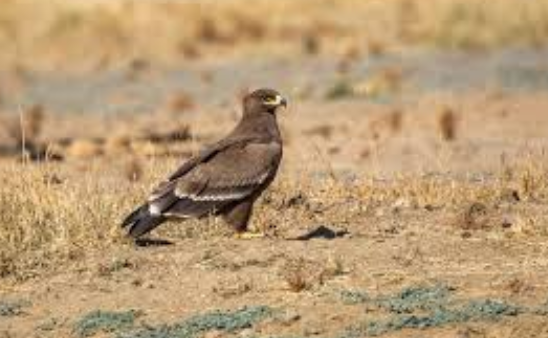
Steppe Eagle: An Overview
The Steppe Eagle belongs to the subfamily Aquilinae, known as “booted eagles.” It is a large, sturdy bird characterized by dark brown feathers, a thick neck, and a relatively small head. Its strong build and ability to soar high make it one of the most striking birds of prey found in open landscapes.
Habitat and Distribution
This species is found in diverse environments such as steppe lands, deserts, semi-deserts, grasslands, savannas, and farmland. It is distributed across Europe, Asia, and parts of Russia, Mongolia. The eagle breeds mainly in Central Asian countries like Kazakhstan, Russia, and Mongolia, and during winter, it migrates southward, with India being a key destination.
Behaviour and Ecological Traits
The Steppe Eagle is a specialized predator mainly feeding on small mammals like ground squirrels, along with birds and reptiles. It is unique because it nest primarily on the ground. Its migratory movement is influenced by seasonal temperature shifts and the availability of food sources.
Important Facts for Exams
- The Steppe Eagle is a migratory bird that winters in India, especially in Rajasthan.
- It belongs to the subfamily Aquilinae (booted eagles).
- It breeds in Central Asia and migrates southward in winter.
- Its conservation status on the IUCN Red List is Endangered.
Threats and Conservation Challenges
The species faces threats such as loss of habitat, human persecution, wildfires, and destruction of nests. Chicks are vulnerable to predators and accidental trampling by livestock. Recognizing Rajasthan as a key wintering site emphasizes the importance of protecting habitats to conserve this endangered bird.
Important Facts for Exams
- Steppe Eagle is a migratory raptor wintering in India, especially Rajasthan.
- It belongs to the subfamily Aquilinae (booted eagles).
- It breeds in Central Asia and migrates south during winter.
- Its IUCN Red List status is Endangered.